Wednesday, 11 May 2011

Indianapolis 500 – 100th Anniversary

There are many automotive racing milestones this year, but without a doubt, the most important is probably the 100th anniversary of the first Indianapolis 500. It also most of the most widely followed sporting events on the planet, so this birthday is doubly important.

That first race was won by Ray Harroun, driving a Marmon Model 32 “Wasp”. His average speed was 74.6 mph (120 kph).

Since that first Indy 500, the race has been won by drivers like Ralph De Palma, Jimmy Murphy, Tommy Milton, Louis Meyer, Wilbur Shaw, Mauri Rose, Bill Vukovich, Roger Ward, A.J. Foyt, Jim Clark, Bobby Unser, Mario Andretti, Al Unser, Mark Donohue, Rick Mears, Emerson Fittipaldi, Arie Luyendyk, Jacques Villeneuve, Hélio Castroneves, Dario Franchitti … and the race speeds have gone up as high as 236 mph (379 kph!)

The most successful racers have been A.J. Foyt, Al Unser and Rick Mears with 4 wins each; the most successful team is by far Penske Racing with 15 victories, their first in 1972 and their most recent in 2009.

The Indy 500 has always been held in the last weekend in May, and has been held every year except the war years of 1917 and 1918, and 1942, 1943, 1944, and 1945.

This year, the Indianapolis 500 is held on the same day as another famous race, the Grand Prix de Monaco … lots of stimulation in one day for motorsports fans!

Thursday, 5 May 2011

Juan Manuel Fangio 1911-1995

This year marks the 100th anniversary of the birth 
of Juan Manuel Fangio.
Limited edition archival Giclee print
Edition of 100 - Signed/numbered - 11"x 17" (28cm x 43cm)
$125 USD plus shipping
© Paul Chenard 2011

Many, including myself, consider this Argentinian racer as the greatest driver of the post-war era.

Born in Balcarce in 1911 to Italian immigrants, Fangio started racing in 1934, driving a Ford Model A that he built. He later raced long-distance road races driving a Chevrolet to success, becoming Argentine National Champion in 1940 and 1941.

In 1948, he went racing in Europe, capturing a few wins, and the notice of the Grand Prix teams. He was hired by Alfa Romeo in 1950, and finished 2nd in the Championship. In 1951, he won his first of five Formula 1 World Drivers’ Championships, again driving for Alfa Romeo. He finished 2nd again in 1953 with Maserati.

In 1953, he also won the La Carrera Panamericana, driving a Lancia D24.

In 1954, he started with Maserati, winning two races, then switched to Mercedes, and won four more races, taking his second Championship.

He won again in 1955, driving for Mercedes, in 1956, driving for Ferrari , and in 1957, driving again with Maserati.


His most famous win came in the 1957 German Grand Prix at the Nürburgring, where he beat a strong Ferrari opposition, driving the famous Maserati 250F. At the same time, he established a new track record.

He retired to Argentina in 1958 at the age of 47. He made countless guest appearances at many automotive events worldwide, and even appeared as himself in John Frankenheimer’s film “Grand Prix”.

The Juan Manuel Fangio Museum opened in Balcarce in 1986. This fine gentleman racer died in 1995 in Buenos Aires at the age of 84.

Thursday, 28 April 2011

Ferrari 156 “Sharknose” 50th Anniversary

This year marks the 50th anniversary of Ferrari's first rear-engined Formula 1 car, the famous 156 “Sharknose”. It was so named because of the distinctive air intake “nostrils” on either side of the front of the racer.

Battle Plans 1961 Black and white pen&ink (14"x 11), digitally painted, available as a limited edition.
© Paul Chenard 2010
The 156 was designed by Carlo Chiti, and was powered by a 1,476 cc V6 “Dino” engine.

The car was driven to success by such notable drivers as Phil Hill, Wolfgang von Trips, Richie Ginther, Giancarlo Baghetti, Ricardo Rodríguez, Lorenzo Bandini, Willy Mairesse and John Surtees.

Belgian Grand Prix 1961 - "Sharknoses" Limited edition of 50 – 14.5”x 11” (36.8 cm x 27.9 cm) – $150 USD plus S/H
American Phil Hill won the Formula 1 World Drivers’ Championship driving the “Sharknose”, with a win at the Belgian and Italian Grands Prix, and podium finishes in Monaco, Nederlands, Great Britain and Germany.


Black & white pen&ink (22"x 17), digitally painted, available as a limited edition signed by Phil Hill.
© Paul Chenard 2007
Sadly, all the “Sharknose” F1 Ferraris were scrapped after the 1963 season, but a few replicas have since been constructed.

Wednesday, 20 April 2011

1934 Grand Prix de Nice

In the beautiful coastal setting of Nice, France, the 1934 Grand Prix was vaguely reminiscent of Monaco.

The racers started along the Quai des États-Unis, with the waterfront and grandstands to their left, and the cityscape and pits to their right.

1934 Grand Prix Season – Grand Prix de Nice – Alfa Romeo P3Limited edition of 50 – 14.5”x 11” (36.8 cm x 27.9 cm) – $150 USD plus S/H

At the green flag, they raced off down the Promenade des Anglais, past the Hôtel Negresco, downshifting quickly at the tight hairpin curve to the right, back down the Promenade, upwards through the city, around the Jardin Albert 1e, and back to the waterfront starting point.

Three Scuderia Ferrari Alfa Romeos (driven by Louis Chiron, Count Trossi, and Achille Varzi) squared off against seven Maseratis (whose drivers included Tazio Nuvolari, Philippe Étancelin, and Whitney Straight), one Bugatti team car driven by René Dreyfus, and some privately entered Alfas, Bugattis, and Maseratis. Both the Mercedes and Auto Union teams chose not to participate.

The race start saw Varzi and Chiron leading, with Nuvolari and Dreyfus battling for third place. Dreyfus crashed out, allowing Nuvolari’s attention to shift to Chiron. But Nuvolari’s Maserati was not up to another duel and threw a piston.

After the necessary pits stops by all the racers, Étancelin’s Maserati took second place, with Trossi slipping into third position.

With Nuvolari’s retirement, there was no one to really challenge Varzi’s lead, and the somber Italian took the race.

Wednesday, 13 April 2011

Bonne fête, monsieur Gurney!


An American racing icon celebrates a birthday; Dan Gurney is 80 years young today.

Born in Port Jefferson, New York, he moved to California as a teenager.

He became a successful racer, winning his first Formula 1 race at the French Grand 1962 driving a Porsche 804; it was also Porsche's first F1 win.

Not satisfied to be just a racer, he was instrumental in getting Colin Chapman to bring his Lotus’ to the Indianapolis 500, finally leading to their win with Jim Clark in 1965.


1967 was a big year for Americans in motor sport, and someone who was at the forefront of it was Dan Gurney.

He won, along with A. J. Foyt, the 24 Heures du Mans in a GT40 Mark IV and remains the only American to win a Formula 1 race in a car of his own construction at Spa in Belgium, racing his Eagle Weslake T1G. At his Le Mans win, Gurney introduced the tradition of spraying Champagne, which has carried from that point on.

In his career, he won races in Nascar, Can-Am, Trans-Am and Indy. Later on, as a team owner/manufacturer, his cars would also win the Indy 500, and the IMSA GTP series.

He is current writing his biography, which we are all looking forward to. There will certainly be some Champagne spraying when that is published!

Wednesday, 6 April 2011

1934 German Grand Prix

After their humiliating defeat at the French Grand Prix by the Scuderia Ferrari team, the German teams were very determined to succeed on their home ground. With nearly 300,000 spectators, including officials of the Third Reich, there was considerable pressure to win.

1934 Grand Prix Season – German Grand Prix – Auto Union Type A
Limited edition of 50 – 14.5”x 11” (36.8 cm x 27.9 cm) – $150 USD plus S/H


The race took place on the long, grueling Nürburgring, called by many racers “the Green Hell.” With a length of over 28 kms (more than 17 miles) and having 187 turns through forests and changing elevations, it’s not difficult to see why.

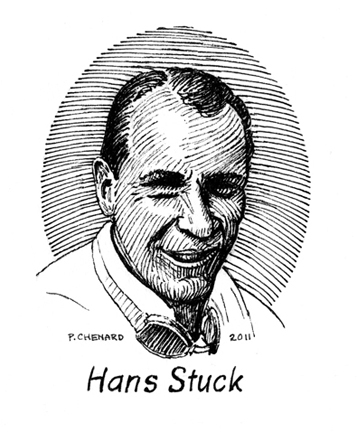
From race start, a battle developed between the leader, Auto Union driver Hans Stuck, and Mercedes driver Rudolf Caracciola. They pulled away from the rest of the pack, breaking lap record after lap record. 

Caracciola manage to get by Stuck at the Karussel curve and take the lead, but the strain was too much for the Mercedes W25’s engine, forcing him to retire.

Luigi Fagioi took up the chase in his teammate’s place, with Louis Chiron driving his Scuderia Ferrari Alfa Romeo P3 in a very distant third place, ahead of Nuvolari’s Maserati.

It was a resounding first win for Stuck and the Auto Union team, with an encouraging second place for Mercedes on the especially challenging track.

Wednesday, 30 March 2011

Ettore Bugatti - Le Patron

Ettore Bugatti, often referred to by staff as “Le Patron”, was born in Milan, Italy in 1881.

He apprenticed at a bicycle factory, where he designed his first motorized vehicle. Subsequently, he worked as an automobile designer for the Dietrich and then the Deutz car companies.


Blue Bugattis at Eau Rouge - 1934 Belgian Grand Prix
 Pen&ink, markers, Prismacolor white pencil and pencil on archival white stock 11.75”x 9”
© Paul Chenard 2010
Limited editions available.

In 1910, he started on his own in Molsheim, France, where he designed the Type 19 for Peugeot, called the “Bébé.”

At the same time, Bugatti was successfully racing a Type 13 “Brescia,” built for competition. This little racer carried the famous “horseshoe” radiator that became an earmark of Bugatti quality.

From the early 1920s to the early 1930s, he developed ever more refined and successful racers, such as Types 18, 35, 35B, 35C, 35T, 37, 37A, 39, 51, 54,and 59, as well as road cars, such as Types 40, 41, 50, 55, and 57.

There is a legend that the shades of blue of the Bugatti racecars were based on blue of the 1930’s Gauloise cigarette packages. Madame Bugatti would pull out her Gauloise package and compare it to the colour being used and have it “adjusted” to match the package.

Bugatti’s son Jean was a dynamic catalyst for change and development within the company. With his death in 1939 in a testing accident, and the ruin of the Molsheim factory during the Second World War, the company fortunes started to diminish.

Philippe "Phi-Phi" Etancelin on his way to winning the 1930 French Grand Prix in Pau, driving his 2-litre supercharged Bugatti Type 35C.
 My first scratchboard illustration 7"x 5" (17.8cm x 12.7cm)
© Paul Chenard 2010

This illustration is available.

Ettore Bugatti passed away in Paris in 1947 at the age of 65.

Wednesday, 23 March 2011

Alfred Neubauer

Born on March 29 1901, Alfred Neubauer fell in love with the automobile as a young boy.

After WWI, he became a racecar driver for Astro-Daimler. He then moved with Ferdinand Porsche to Mercedes, where he would find his life-long professional home. By 1926, it was apparent that Neubauer was a much better manager than driver. He was soon recruiting quality drivers such Rudolf Caracciola to the team.

While manager of the race team, he brought into play various ways to communicate to the drivers during the races, such as hand signals and pit-boards, presenting them with useful information like race position, laps remaining, when to pit for fuel, etc. These communications methods have been adopted for races worldwide.

As a large man with a booming voice, Neubauer commanded attention and respect from his team and the officials. He was strict but fair on the track, and incredibly entertaining as a dinner host.
He led his team to great success before and after WWII, with Mercedes winning the Mille Miglia (1931, 1955), the Targa Florio (1955), six European and Grand Prix Championships (1935, 1937, 1938, 1954, 1955), along with wins at Le Mans (1952) and La Carrera Panamericana (1952).

Neubauer retired as race team manager in 1955, and passed away in 1980.

Wednesday, 16 March 2011

Grand Prix de France 1934

The French Grand Prix in Montlhéry, just south of Paris, signaled the return of Rudolf Caracciola with the Mercedes Team, having spent the last fourteen months recovering from a serious accident.

Auto Union was present, along with the Scuderia Ferrari Alfa Romeos and a couple of Maseratis. Tazio Nuvolari was invited to try the Bugatti Type 59 by Ettore Bugatti.

At race start, Louis Chiron driving for Scuderia Ferrari quickly took the lead from Caracciola, Luigi Fagioli (Mercedes) and Hans Stuck (Auto Union). Stuck than pushed hard past the Mercedes drivers to take the lead from Chiron.

Nuvolari experienced gearbox trouble in the Bugatti so he handed it off to Jean-Pierre Wimille. Fagioli was instructed to push harder to catch the lead cars.

The high pace of the race started taking it’s toll on the new German cars, and one by one they dropped out, Caracciola with fuel-feed problems, Fagioli with a broken brake-line, von Brauchitsch with supercharger woes, the persistent Stuck with engine problems, and Momberger with a steering break.

The other teams also dropped out, Bugatti with mostly engine and transmission issues, and Maserati with axle and engine breaks.

Trossi, Chiron and Varzi, race-ready for Scuderia Ferrari
Pen&ink, markers and pencil on white archival stock 12”x 9” (30.5cm x 22.9cm) © Paul Chenard 2010
Original sketch available, as is the limited edition.

This led to a clean sweep for the Scuderia Ferrari Alfa Romeos with Chiron first, Varzi second and the Trossi/Moll duo third.

The 80,000 spectators were thrilled with Chiron’s win over the Germans teams. This win hid the fact that all the German cars, though still being very new, fell out of the race for fairly minor reasons, and that with better preparation, they would have clearly matched the opposition.

Wednesday, 9 March 2011

Circuito Di Modena Grand Prix 1934


At the beginning of the season, Tazio Nuvolari was recovering from a crash in Alessandria. Once he was back in form, Ettore Bugatti offered him the Type 59, which Nuvolari disliked (poor brakes and acceleration). He chose instead to take his skills to the Maserati team, driving their somewhat under-classed 8CM.

This car did not do well for him, finishing very few races he started.

For the Italian Grand Prix, Nuvolari debuted a promising new model, the 6C-34. It ran a 3.7 litre supercharged straight-six cylinder engine giving it 270 bhp, good for 155 mph (250 kph).

Unfortunately for Nuvolari, the mechanics forgot to refill the break-reservoir so that he raced without his breaks, yet he still finished 5
th!

For most of the remainder of the season, the Maserati team worked very hard to find reliability in the new car, with little success.
Pen&ink, markers and pencil on white archival stock
© Paul Chenard 2011

The true potential of the 6C-34 came to the front at the Modena Grand Prix. Nuvolari came against the full might of the Scuderia Ferrari team, passing each one to finally take the lead from Varzi, and merrily thumbing his nose at Ferrari as he won.

Nuvolari would follow this up with another win at the Circuito di Napoli race. This was the last official race of European racing season.

Wednesday, 2 March 2011

Artist Nicolas Cancelier

In the past few years, I’ve been lucky enough to meet all kinds of people with the same passion for art and motor sports history as I have.

One of these is Belgian artist Nicolas Cancelier. 


His artwork is absolutely stunning, and it ranges from simple pencils sketches to mixed media, acrylic, watercolour, and oils.

The energy and life he brings to his subjects is masterful, whatever medium he chooses.


In the past year, we’ve become very good friends, and we’ve decided to share vendor space at the very prestigious Goodwood Revival in September. I hope that if you are there, that you’ll drop in and see us.

You can see Nicolas’ work on his website and his blog. Very much worth a look!

Wednesday, 23 February 2011

Herbert Müller – Nürburgring 1971


At the 2007 Mosport Vintage Racing Festival, I had to honour of meeting Peter Felder, who was Swiss driver Herbert Müller’s best friend and race team manager. We’ve been friends ever since, and Peter has come to visit me a few times in Nova Scotia. Peter’s stories of his racing experiences are completely captivating; he was kind enough to write one of these down for me:

In 1971, Herbie decided to run one of his Ferrari 512 M’s in an InterSeries race at the Nürburgring. (Unfortunately, Pedro Rodriguez perished in one of his 512’s at the Norisring a few months earlier). In any case, Herbie had transmission problems in qualifying and subsequently started last. At the start, the last rows were still in the last corner before the start-finish line. A young, wealthy German driver in a McLaren M8C, not being used to the torque of a 427, he spun coming on to the starting straight, in the process crashing into Herbie’s 512. The red 512 became airborne, flew across the track upside down and hit the pit lane guardrail; the guardrail sliced into the car right behind the driver seat, which caused an immediate explosion. The car landed in the pit lane, still upside down and fully engulfed in burning fuel.

The following is what Herbie told me afterwards in the hospital:

“There was a tremendous crash … I knew that I was flying through the air because I saw the blue sky behind the pits … and I knew that the car was on fire...and I though ‘This is not going to be good’. I braced myself waiting for some kind of impact, which is what happened … twice! All I was worried about was not to hit my head anywhere … then the car came to a stop … and I immediately release my seatbelt and since I didn’t know that I landed upside down, I fell into the burning fuel. I turned myself around … tried to kick open the door … no go … considered knocking out the windshield … didn’t work … so I tried the other door … and it opened enough for me to get through … and I knew that I was on fire … tried to figure out where to run … (and here comes the kicker) you know those Germans … I remember seeing a couple of fancy Mercedes cars on display next to the tower, so I thought … if I run towards the cars, somebody will try to save me so I don’t blow up the Mercs!”

Herbie and I had a lot of laughs about this whole ordeal.

Regrettably I was with him on May 24th 1981, or ten years later, at the same track, when he crashed into Bobby Rahal’s crashed, stationary, Coca Cola sponsored, Bob Aiken owned 935.

Later that day I went to the Adenau hospital … but this time, we could not laugh together.

Sunday, 20 February 2011

Buon compleanno, signor Ferrari!

Officially, today is Enzo Ferrari’s birthday, records showing that he was born this day 113 years ago.

In actual fact, he was born two days earlier, February 18th on the outskirts of Modena, during a bitter winter storm. The storm delayed the registration of his birth, and so it came to be the later date.

Buon compleanno, signor Ferrari!

Wednesday, 16 February 2011

Artist Rob Roy

Rob Roy (née Richard de la Rivière) was an artist born in Mont-de-Marsan in the south west of France in 1909.

From an early age, he had his father’s passion for motorized vehicles and art. He developed a talent of accurately and vividly documenting the events around him with his art, which was mostly motor racing. Between the wars, he did his watercolours, and at times, managed to also do some racing.

Grand Prix de Monaco 1935
Mercedes W25 & Alfa Romeo P3

He captured the racers of the time, Nuvolari, Varzi, Chiron, Caracciola, Ascari, Fagioli, Sommer, Dreyfus, and so on, his watercolours portraying their tight battles of the tracks of Europe.

Coupe Internationale des Voiturettes, Le Mans 1920
Bugatti Type 13 & Fiat

Prior to World War II, Rob Roy had joined to army, so when the war started, he joined the 3rd Tank Battalion. He was captured but later managed to escape. He kept a diary and did art-pieces of his war experiences, which have recently been published as a book “Carnet de guerre de Rob Roy 1939 à 1944.”

Mille Miglia 1936 
Alfa Romeo 8C 2300 Monza

After the war, he worked in the automobile industry, and continued to do art for advertisements, brochures, magazines, books and posters.

He stayed involved with his motor racing friends and doing his motor racing art until his passing 1992.

Recently, I was lucky enough to find three Rob Roy prints locally for my racing automobilia collection; they are wonderful records of racing past.

You can find out more on Rob Roy at this website: http://www.art-robroy.com/index_en.htm

Wednesday, 9 February 2011

1934 Grand Prix de Monaco

As the first “Grande Épreuve” of the 1934 Grand Prix season, Monaco was, and has always been, a dramatic venue on the Mediterranean Sea.

It is one of few city courses in the world and considered the most prestigious of all the Grand Prix’s. The Monaco Grand Prix’s started in 1929 and it is still run today.


Guy Moll in an Alfa Romeo P3 rounding the Station Hairpin ahead of René Dreyfus in a Bugatti Type 59
Pen&ink, markers, and pencil on archival white stock 12”x 9” 
© Paul Chenard 2010

Original art & limited editions available.

For this April 2nd race, a few of the cars running needed modification to meet the new 750kg rules. Both the Mercedes-Benz and Auto Union teams decided they would not participate in any racing until the May 27th Avusrennen.

From the flag, the race lead changed hands quite often between the Bugatti T59 of René Dreyfus and the Scuderia Ferrari Alfa Romeo P3’s of Louis Chiron and “Guy” Moll.

Pen&ink © Paul Chenard 2010

Later in the race, while Chiron was in front, he had a slight off at the Station Hairpin, relinquishing his lead to Moll, who kept his position till race end.

It was a great start for this talented and popular 24-year-old Algerian rookie Scuderia Ferrari driver.

Tuesday, 1 February 2011

Jaguar E-Type 50th Anniversary

The sports car that some consider the most alluring in the world is celebrating it’s 50th anniversary this year.

The late Malcolm Sayer’s stunning design completely wowed the public and the media at it’s launch in 1961; even Enzo Ferrari called it “ the most beautiful car in the world.”

The E-Type’s looks, cost, and performance were completely unmatched in it’s day, and it still easily draws a crowd today.

Pen&ink and Prismacolor pencils on green archival paper
© Paul Chenard 2011

Historic Car Art has asked me to create an artwork to honour the E-Type; it will be presented at Race Retro in late February.

Limited editions of this piece are also available.