Showing posts with label 1967. Show all posts

Friday, 7 April 2017

Lotus Ford Cosworth 49

As Formula 1 engine capacity rules changed from 1.5 liters to 3 liters (or 1.5 liters compressed) for the 1966-1986 seasons, a few manufacturers were left scrambling for suitable power plants.

For 1966, Lotus raced their 33 with both a Climax V8 and BRM V8 and H16 engines, with poor results. They also raced their model 43 BRM to one win.

In the background, Lotus Team owner Colin Chapman was busy convincing the Ford Motor Company to finance the design and build of a new 3 liter V8. Cosworth Engineering Ltd, a successful racing engineering company created by Mike Costin and Frank Duckworth, was commissioned to undertake the new design.


The Ford Cosworth married to the Lotus 49 chassis

As in their model 43, Lotus wanted to design the chassis with the engine as a load-bearing structure carrying the rear suspension. Colin Chapman and fellow designer Maurice Phillipe worked very closely in parallel with Cosworth to assure the success of this approach.


Colin Chapman waits as the mechanics prep the new Lotus 49 for it's first race.

The new Ford Cosworth DFV V8 was introduced in late April 1967, and the Lotus/Cosworth engineering worked hard to have the engine/chassis package ready for it race introduction at the Dutch Grand Prix held at Zandvoort on June 4.


Jim Clark on his way to winning the 1967 Dutch Grand Prix in the new Lotus 49.

Lotus driver Graham Hill easily won pole position, with fellow driver Jim Clark started in 8th place on the grid. As the race started, Hill quickly pulled away from the pack, holding the lead till his engine gave up. In the meantime, Clark moved up through the cars to take on the lead and win the race! An astonishing debut for a new car!

Unfortunately, the engine and chassis were not without their little gremlins, which allowed Denny Hulme racing the Brabham Repco to take the Championship.

For the 1968 season, the de-bugged package did it’s magic, with Graham Hill rallying the team after Jim Clack’s death in an F2 race and taking the Championship for Lotus in the 49B.
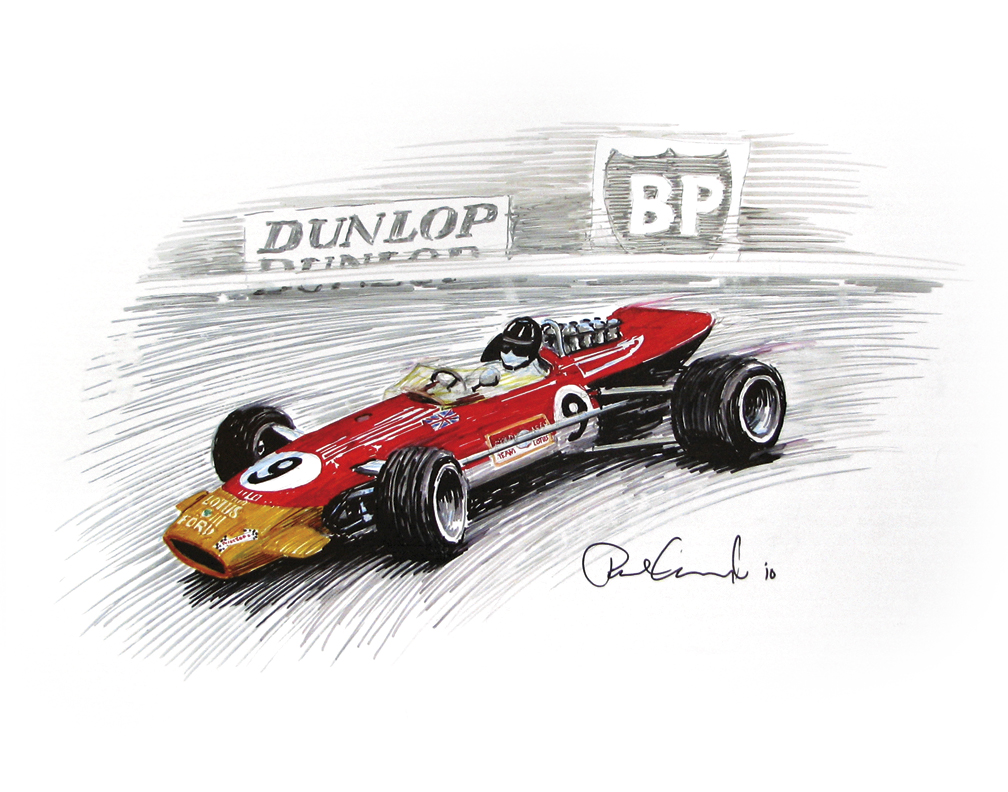

Graham Hill on his way to winning the 1968 Grand Prix de Monaco in the 49B.

Interestingly for 1968, Lotus’ Team no longer carried British racing green, but instead the sponsorship colours of Gold Leaf cigarettes, a step that would change the face of Formula 1 sponsorship, and the car’s colours …


Saturday, 18 April 2015

Bluebird-Proteus CN7 Record Car

The Campbell family legacy of breaking land speed records goes back to Sir Malcolm Campbell born in the county of Kent, England in 1885.

He was a racing driver and journalist who took on the challenge, between 1924 and 1935, of setting numerous land speed records in various cars that he choose to christen “Bluebird”.

Sir Malcolm passed away in 1948, and his son Donald, born in 1921, decided to take on the challenge of speed.

He started on water with his father’s old record boat Bluebird K4. With modifications, the boat showed great promise, but he did not manage to set any new records with it.

Donald commissioned a new boat the Bluebird K7 of extremely advanced design, and through the 1950’s, set many new water speed records.

At the end of the 1950’s, he commissioned a land speed record car, which he christened Bluebird-Proteus CN7. It was a stunningly beautiful car, powered by a modified Bristol-Siddeley Proteus turbine engine driving all 4 wheels.


Corgi #153 Proteus Campbell Bluebird (1960-1965)

In 1960, he brought Bluebird to the Bonneville Salt Flats in Utah, USA for testing. After various trial runs, making adjustments all along, Campbell crashed CN7, damaging it extensively and putting himself in hospital.

It was rebuilt through 1962 with a tail fin to add stability and was tested in 1963 on Eyre Lake, a normally dry lakebed in Australia.

After many months of bad conditions for a land speed run, there was a break in the weather and on July 17, 1964, Campbell decided to go for it.


Bluebird-Proteus CN7 on it's record run
Acrylic, pen&ink and colour pencils on 24"x 10.5" (60.9cm x 25.4cm) watercolour paper
© Paul Chenard  - Original art available -


On his two courageous runs, he brought Bluebird to an average speed of 403.10 mph (648.73 km/h), a new world land speed record for a wheel-driven car. Victory was his!!!

Sadly, Donald Malcolm Campbell CBE was killed while attempting a new world water speed record in the modified Bluebird K7 on Coniston Water, Lancashire, UK on the 4th of January 1967.

Wednesday, 7 August 2013

Ford GT40 @ 50

50 years ago this year, one of the most iconic GT/sports racing cars appeared on the scene.

In the early 1960’s, Henry Ford II launched the “Total Performance” program, hoping that the race-winning image would push Ford automotive sales worldwide.


Though the campaign covered all matter of motor sports, Ford was particularly focused on the 24 Heures du Mans, which is considered one of the world’s most prestigious races.

Ford attempted to purchase Ferrari, who had won 6 times in a row (1960-1965), hoping that together, they could win Le Mans. Ferrari back out of negotiations, having used Ford’s bid as leverage for a deal with Fiat.

This enraged Ford, and he vowed to put all of his company’s resources into beating GT/sports Ferrari on tracks worldwide, with a primary focus on Le Mans.

Pen&ink and markers on light blue archival stock
© Paul Chenard 2013

The resulting British-designed/built race car was designated the GT40, GT standing for Grand Touring, and 40 representing its overall height of 40 inches.

After a few years of ironing the bugs out, Ford’s GT40’s took the first 3 spots in the 1966 running of Le Mans, racing Mark II’s.

In the 1967, Ford returned with the American-developed and built GT40 Mark IV’s, and took the first spot, famously driven by Dan Gurney and A.J. Foyt.

By 1968, Ford decided that they had reached their goal, and shut the GT40 program down. John Wyer’s Gulf Racing team (J.W. Automotive Engineering Ltd.) took some of the GT40 Mark II’s and brought them to Le Mans in a high level of fit and finish.

They took the 1968 (drivers Pedro Rodriguez and Lucien Bianchi), and 1969 (Jacky Ickx and Jackie Oliver) 24 Heures du Mans, both in the exact same car!

By 1970, the GT40 was just another obsolete race car, and Porsche took the Le Mans rei(g)ns. Today the GT4o is a highly respected collectable.

Sunday, 28 April 2013

911@50 – “Quick Vic” and the Porsche 911

Victor Henry Elford started rally racing in the early 1960’s, slowly gaining experience and success.

In 1963, Porsche introduced the Ferdinand “Bitzi” Porsche–designed 911 as a refined replacement to their 356.

In early 1967, Vic Elford met with Porsche racing team manager Baron Fritz Huschke von Hanstein and convinced him of the competition potential of the 911 in rally racing.

Elford was right and successfully took the 1967 European Rally Championship in the works 911.


Pen&ink and markers on archival watercolour paper
12"x 18" (30.5cm X 45.7cm)
© Paul Chenard 2013

 In 1968, he took a Porsche 911T, along with navigator David Stone, to a very popular win of the grueling Rally Monte Carlo.

It was the only the beginning of legendary competition success of the many storied Porsche 911, which this year, celebrates it’s 50th anniversary.

Alles Gute zum Geburtstag!

Monday, 12 March 2012

The STP Turbocar

The 1960’s were a period of great change and experimentation in American Champ car racing, sanctioned by the United States Auto Club (USAC).

Nowhere was there more experimentation than the annual Indianapolis 500.

For two decades, all of the Indianapolis winning cars were front-engined roadsters, mostly powered by the famous 4-cylinder Offenhauser (Offy) engine.

After Jack Brabham raced a rear-engined Cooper to 9th place in the 1961 race, Colin Chapman took notice, bringing rear-engined Lotus Indy cars to the race, starting in 1963. They finally succeeded in 1965, with Jim Clark winning in a Ford-Cosworth powered Lotus 38.

STP Turbocar

Pen&ink, paint-markers and markers on red archival stock © Paul Chenard 2012

In 1967, another dramatic new racer was presented at the Indianapolis 500. Envisioned by STP President Andy Granatelli, the race car was designed by Ken Wallis, and used a Ferguson 4-wheel-drive systems. The biggest surprise was that it was powered by gas turbine helicopter engine located beside the driver!

For this Indianapolis 500, the grid was almost completely dominated by rear-engined race cars. Granatelli’s STP Turbocar was raced by Parnelli Jones, who loved driving the car.

Jones took an early lead and led the race for 171 of the 200 laps. He was well on his way to victory when a $6 bearing in the gearbox failed, dropping his car into neutral. A. J. Foyt took the lead from Jones in his own rear-engined Coyote and won the race.

It was a frustration end to a near perfect and memorable race for Jones and the famous STP Turbocar.

Saturday, 14 January 2012

Richie Ginther: The Race Car Developer

Paul Richard “Richie” Ginther was born in Granada Hills, California in 1930.

He was raised in the same town as Phil Hill, and worked for Douglas Aircraft in the tool and die shop. Ginther met Hill and helped him in the repair and maintenance of his race cars.

He started his own race career in 1951, driving a Ford-powered MG. Shortly afterward, he was drafted to the Korean war, and worked on aircraft maintenance. 
Page from the 1959 Fuller Brush catalog.

Once out of the military, Ginther was drafted by Hill as his riding mechanic for the 1953 Carrera Panamericana, racing in a Ferrari 340 Mexico Vignale. They ran well until they left the road and severely damaged the Ferrari. They returned the following year, racing a Ferrari 375 MM Vignale and finished in second place.

Page from the 1959 Fuller Brush catalog.

Not long after Hill left for Europe to drive for Scuderia Ferrari, and Ginther took his place in the States, racing more and more frequently, gaining successes.

He drove Healeys, Porsches, Aston Martins, and finally Ferraris. He moved to Europe, joining Hill with Ferrari, where he stayed for the 1960 and 1961 seasons. He was instrumental in the race development of the famous 156 F1 “Sharknose”.

Sharknoses at Spa 1961, where Ginther finished in 3rd place. Pen&ink, pencils and markers on white archival stock 12"x 9" © Paul Chenard 2012


From there he moved to BRM for 1962, also helping in the development of their Championship-winning P57 Formula 1 car.

Tamiya 1/20 Honda RA272 kit that I built.

He joined Honda in 1965, racing their new RA272 F1 car. In the last Grand Prix of the season in Mexico, he won the race, giving Honda and Goodyear their first Formula 1 win. Unfortunately, it was Ginther’s only Formula 1 win.

Sketch on a package I shipped to California for a good client.
Pen&ink and markers on Foamcore.  © Paul Chenard 2012

Ginther had a small part in John Frankenheimer’s 1966 film “Grand Prix.”

Ginther finally retired in 1967, and sadly passed away in 1989 while camping with his family in France.

Wednesday, 13 April 2011

Bonne fête, monsieur Gurney!


An American racing icon celebrates a birthday; Dan Gurney is 80 years young today.

Born in Port Jefferson, New York, he moved to California as a teenager.

He became a successful racer, winning his first Formula 1 race at the French Grand 1962 driving a Porsche 804; it was also Porsche's first F1 win.

Not satisfied to be just a racer, he was instrumental in getting Colin Chapman to bring his Lotus’ to the Indianapolis 500, finally leading to their win with Jim Clark in 1965.


1967 was a big year for Americans in motor sport, and someone who was at the forefront of it was Dan Gurney.

He won, along with A. J. Foyt, the 24 Heures du Mans in a GT40 Mark IV and remains the only American to win a Formula 1 race in a car of his own construction at Spa in Belgium, racing his Eagle Weslake T1G. At his Le Mans win, Gurney introduced the tradition of spraying Champagne, which has carried from that point on.

In his career, he won races in Nascar, Can-Am, Trans-Am and Indy. Later on, as a team owner/manufacturer, his cars would also win the Indy 500, and the IMSA GTP series.

He is current writing his biography, which we are all looking forward to. There will certainly be some Champagne spraying when that is published!

Sunday, 21 February 2010

Making 3D out of 2D …

The Lotus 49 was another of a long line of brilliant Colin Chapman (and Maurice Phillipe) designs, being the first Formula 1 racecar to successfully use the motor as a stress-bearing structural member.

Jim Clark won 4 races in 1967 driving the Lotus 49, and the first race of the 1968 season before being tragically killed in an F2 race in Hockenheim.

I decided to illustrate a "faux" 1967 Silverstone poster, done in the old mid '60s British style.

In the sketch, Clark leads 2nd place finisher Denny Hulme in his Brabham BT24, followed by 3rd place Chris Amon in his Ferrari 312 F1.

As an experiment, I wanted to render a normally 2D sketch into 3D. To create the 3D illusion, I had to illustrate the cars in parts, and then assemble the parts onto the illustrated background.

For example, the Clark Lotus 49 is built from 9 separate illustrations, cut out, and assembled in layers to create a "trompe l'oeil". The 3 cars are done like that, and positioned into their 1st, 2nd, and 3rd race finishing order. The "Silverstone" text is also cut out paper ...

Prismacolor pencils on individual coloured papers, cut out and layered onto background

© Paul Chenard 2010

Marc Hogenkamp Collection

Commissions are available.

Monday, 20 July 2009

“Go Like Hell” – A Book Review

Houghton Mifflin Harcourt was kind enough to send me this book to review on my blog; here it is.

As I closed the cover of A. J. Baime’s book “Go Like Hell”, all I could think of was “hell-of-a-book”!

The book’s subtitle is “Ford, Ferrari, and their Battle for Speed and Glory at Le Mans”, and that sums up very well the subject of his book.

Baime, an executive editor at Playboy magazine, has obviously done some extensive research to put the story together, with interviews with the some of major participants, and their associates, to get the inside perspective. I very much enjoyed finding out more of the players in this vast story, in particular Ken Miles, Phil Hill and John Surtees.

This is not at all a clinical analysis of what happened, but gets right in on the feeling of the 1950’s through to the late 1960’s, and the huge clashes of culture going on then.

These numerous culture clashes float up through the background of racing, spiraling into that landmark 1966 Le Mans: hot-rodders vs engineers, time vs development, American vs Italian, horsepower vs cylinders, corporate vs casual, global vs national, staid vs flashy, speed vs safety, individual vs team …

It’s all there, working together, bringing us through this exciting period of history.

The book is very easy to read thanks to the fine layout and design of graphic designer Brian Moore, who obviously researched his subject to bring in some subtile design touches.

Though I found only one very minor error in the book, there are two points with which I really take issue.

The title “Go Like Hell” is not a quote from the book (I couldn’t find it); it’s weak and totally misses to point of the story. “Speed and Glory” from the subtitle is a much stronger and accurate title to this book, and much more attractive.

The cover, which unfortunately was not designed by Mr. Moore, is horrendous. There are two possibly interesting front cover photos obliterated by a typographic monstrosity that looks like a “TIDE” logo. As I always tell my clients, it cost just as much to do it wrong as to do it right … unfortunately, they are not even close to doing the cover right here, and they are more than 8.36 miles off …

Most of us know this story, and we also know how it ends.
But A. J. Baime gives us the behind-the-scenes and the hard to find insights that make it enthralling.

You can pick it up here at Amazon ... you won't regret it!

Thursday, 27 November 2008

Formula 1 Prints - Driver/Constructor/Winner Series


1 Brabham BT19 1966
2 Eagle Weslake T1G 1967
3 McLaren M7A 1968

Pencil on paper © Paul Chenard 2007


The series highlights the 3 Formula 1 driver/constructors who won a race and gained championship points in the car they built.

Sir Jack Brabham won the World Driver's Championship for 1966, and Dan Gurney and Bruce McLaren both won a race in Spa in 1967, and 1968, respectively.

Sir Jack Brabham sent me a note when he saw the BT19 sketch:

Dear Paul,
Thank you for the very nice pencil sketch of the BT19.
Jack Brabham
Wow! I was thrilled to hear from Sir Jack directly.

Each illustration is available as a limited edition of 250 signed and numbered 17" x 14.5" premium archival Giclee prints for $125 CDN each plus shipping/handling.


Tuesday, 25 November 2008

Eagle Weslake - Spa 1967


Pen & ink and Primacolor pencils on white archival stock 4"x 9" © Paul Chenard 2008

Gary Faules Collection

1967 was a big year for Americans in motor sport, and someone who was at the forefront of it was Dan Gurney.

He won, along with A. J. Foyt, the 24 Heures du Mans in a GT40 Mark IV and remains the only American to win a Formula 1 race in a car of his own construction at Spa in Belgium.

In his career, he won races in Nascar, Can-Am, Trans-Am and Indy. Later on, as a team owner/manufacturer, his cars would also win the Indy 500, and the IMSA GTP series.