Showing posts with label 1934. Show all posts

Monday, 25 August 2014

A Story of the Silver Arrows …

I’ve recently corresponded with the Mercedes-Benz Museum Archives, and they very kindly sent me copies of their publication “Magical Moments – 120 Years of Motorsport”.


One of Mercedes-Benz early racing successes, the 1914 French Grand Prix.

There is a great cross-section of their motorsports successes from 1894 till now.


As I read through the publication, an interesting story was featured in relation to the 1934 Grand Prix season.


The AIACR, the controlling body of motor sport in the 1930s, introduced new rules for the 1934-37 Grand Prix seasons:

1.
The weight of the car without driver, fuel, oil, water or tires should not exceed 750 kg.
2. A minimum bodywork width of 850 mm at the driving seat.
3. Free choice of fuel.
4. All races must be over a minimum distance of 500 kilometers.

In the story, it recounts the famous legend of the switch from the traditional and official German white on Mercedes-Benz race cars to the colour silver.


Alfred Neubauer, the Mercedes-Benz racing manager of the time, claimed that the day before the June 3rd, 1934 international Eifel race, they weighed their newly introduced W25 Grand Prix race car, and found that it weighed over the 750kg limit, coming in at 752kg.


The Mercedes-Benz W25 Grand Prix car on it's way to winning the Eifelrennen.

In a flash of inspiration, he had his technicians work overnight to remove the white paint, exposing the beautiful aluminum bodies of these technically advanced racers, bringing them to exactly 750kg, and they won the race. This sparked the legend of the “Silver Arrows”, as the press was to soon label them.


The very successful Mercedes-Benz W25 Grand Prix car.

In the past few years, a few motorsport historians have questioned the credibility of the story.

As I researched my book “Silver Clouds: The 1934 Grand Prix Season”, I have to say that I developed the same doubts.


There are a few facts and insights that I can bring forward:

 1)
In the same year, Auto Union (a merger of Audi, DKW, Horch and Wanderer) presented their rear-engined Grand Prix cars under the same 750kg rules, never in any other colour but silver.

 2)
I find it hard to believe that in the thorough testing their sometimes white-painted W25, that the Mercedes-Benz technicians wouldn’t have weighed the racer well before any actual racing would take place.

 3)
The actual June 3rd, 1934 race was a Formule Libre race, and not under any of the restrictions of the 750kg Formula. In other words, it seems quite implausible that they would work so hard at removing 1kg of paint for an unrestricted race.


With these points, you can still ask, “Why the story then?


Well, for one point, it features the absolute precision of the Mercedes-Benz technicians and engineers, who considered the race machine only, not such frivolous things as the paint.


It also shows the creative quick-thinking of the legendary Mercedes-Benz race team manager Alfred Neubauer, always the clever strategizer.


Yes, it’s a damn good story, true or not …

Tuesday, 30 October 2012

Mercedes-Benz W25

Until 1934, three automotive companies dominated Grand Prix racing: Alfa Romeo, Bugatti, and Maserati. Each year, these companies produced racecars that were faster and more powerful than those of the previous year.

The Association Internationale des Automobile Clubs Reconnus (AIACR), the controlling body for motor sport in the 1930s, decided to change the requirements for the 1934, 1935, and 1936 Grand Prix seasons. The most important new requirement for the racers was that the maximum weight could not exceed 750 kg, excluding driver, fuel, oil, water, and tires.

The AIACR believed that Grand Prix cars were becoming too fast and reasoned that the change in weight parameters would limit the size of the engines used.

However, the AIACR had not at all taken into consideration the possibility of the manufacturers using new technology and lightweight metallurgy to create yet more powerful, efficient racers.

Mercedes-Benz saw an opportunity to move ahead, promoting their know-how and the sale of their products through Grand Prix racing.


Luigi Fagioli on his way to winning the 1935 Grand Prix de Monaco in the Mercedes-Benz W25.

I did this sketch while waiting for my Halifax flight at gate B05 at the Montréal airport on September 24th. The guy next to me practicing on his guitar; it was great to sketch to this guy's music.

Pen&ink, paint markers and markers on gray archival stock 12"x 9" © Paul Chenard 2012

Mercedes-Benz took a traditional approach with the front-engined rear-drive racer, but also took a serious look at using innovative aerodynamics and lightweight materials to give them an advantage. A steel-blocked 3.36-litre straight-8 supercharged engine powered the new Mercedes W25, and it was wrapped in a beautiful aerodynamic aluminum skin, with all-round independent suspension.

In that first year of the new formula, they won the Coppa Acerbo, the Italian Grand Prix and the Spanish Grand Prix. For 1935, they won 9 major races, giving driver Rudolf Caracciola the European Championship.

Thursday, 26 May 2011

Silver Clouds: The 1934 Grand Prix Season

It was inevitable that my love of drawing would one day lead me to express artistically my passion for Grand Prix racing history.


In researching the racing history of the 1930s, I came across material that captivated me. There were many stories about technological developments, about political manoeuvres, about rivalries between racecar teams, and, above all, about drivers.


In particular, the 1934 Grand Prix season formed a turning point in Grand Prix racing history. Disrupting the ebb and flow of the established racing teams’ fortunes and successes, two new, powerful teams suddenly joined the fray of the 1934 season. These teams would establish clear and total Grand Prix dominance from 1935 to 1939, but their auspicious performances in 1934 did not go without notice.


With the idea of passing on these great stories, I decided to write a little book and provide an illustrated overview of the season, with a focus on the 9 key races and 12 of the people who were part of it.


After months of research, writing, creating art, design, layout and finally, assembly and packaging, my little less than perfect book on the 1934 Grand Prix season is ready and available. It’s published as a limited edition of only 50 copies, signed, numbered and custom wrapped.


It’s been a stimulating exercise of tying it all together, visually and narratively.


I hope that the story, the art and the package will offer the reader a memorable experience.


Please contact me at paul.chenard@hotmail.com if you are interested in purchasing a copy.


Wednesday, 20 April 2011

1934 Grand Prix de Nice

In the beautiful coastal setting of Nice, France, the 1934 Grand Prix was vaguely reminiscent of Monaco.

The racers started along the Quai des États-Unis, with the waterfront and grandstands to their left, and the cityscape and pits to their right.

1934 Grand Prix Season – Grand Prix de Nice – Alfa Romeo P3Limited edition of 50 – 14.5”x 11” (36.8 cm x 27.9 cm) – $150 USD plus S/H

At the green flag, they raced off down the Promenade des Anglais, past the Hôtel Negresco, downshifting quickly at the tight hairpin curve to the right, back down the Promenade, upwards through the city, around the Jardin Albert 1e, and back to the waterfront starting point.

Three Scuderia Ferrari Alfa Romeos (driven by Louis Chiron, Count Trossi, and Achille Varzi) squared off against seven Maseratis (whose drivers included Tazio Nuvolari, Philippe Étancelin, and Whitney Straight), one Bugatti team car driven by René Dreyfus, and some privately entered Alfas, Bugattis, and Maseratis. Both the Mercedes and Auto Union teams chose not to participate.

The race start saw Varzi and Chiron leading, with Nuvolari and Dreyfus battling for third place. Dreyfus crashed out, allowing Nuvolari’s attention to shift to Chiron. But Nuvolari’s Maserati was not up to another duel and threw a piston.

After the necessary pits stops by all the racers, Étancelin’s Maserati took second place, with Trossi slipping into third position.

With Nuvolari’s retirement, there was no one to really challenge Varzi’s lead, and the somber Italian took the race.

Wednesday, 6 April 2011

1934 German Grand Prix

After their humiliating defeat at the French Grand Prix by the Scuderia Ferrari team, the German teams were very determined to succeed on their home ground. With nearly 300,000 spectators, including officials of the Third Reich, there was considerable pressure to win.

1934 Grand Prix Season – German Grand Prix – Auto Union Type A
Limited edition of 50 – 14.5”x 11” (36.8 cm x 27.9 cm) – $150 USD plus S/H


The race took place on the long, grueling Nürburgring, called by many racers “the Green Hell.” With a length of over 28 kms (more than 17 miles) and having 187 turns through forests and changing elevations, it’s not difficult to see why.

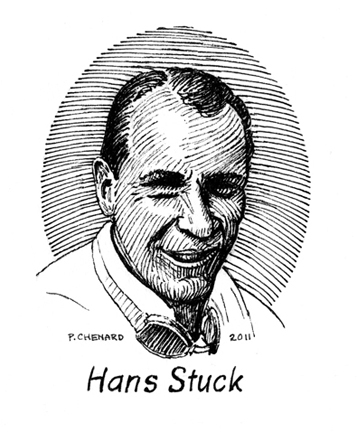
From race start, a battle developed between the leader, Auto Union driver Hans Stuck, and Mercedes driver Rudolf Caracciola. They pulled away from the rest of the pack, breaking lap record after lap record. 

Caracciola manage to get by Stuck at the Karussel curve and take the lead, but the strain was too much for the Mercedes W25’s engine, forcing him to retire.

Luigi Fagioi took up the chase in his teammate’s place, with Louis Chiron driving his Scuderia Ferrari Alfa Romeo P3 in a very distant third place, ahead of Nuvolari’s Maserati.

It was a resounding first win for Stuck and the Auto Union team, with an encouraging second place for Mercedes on the especially challenging track.

Wednesday, 16 March 2011

Grand Prix de France 1934

The French Grand Prix in Montlhéry, just south of Paris, signaled the return of Rudolf Caracciola with the Mercedes Team, having spent the last fourteen months recovering from a serious accident.

Auto Union was present, along with the Scuderia Ferrari Alfa Romeos and a couple of Maseratis. Tazio Nuvolari was invited to try the Bugatti Type 59 by Ettore Bugatti.

At race start, Louis Chiron driving for Scuderia Ferrari quickly took the lead from Caracciola, Luigi Fagioli (Mercedes) and Hans Stuck (Auto Union). Stuck than pushed hard past the Mercedes drivers to take the lead from Chiron.

Nuvolari experienced gearbox trouble in the Bugatti so he handed it off to Jean-Pierre Wimille. Fagioli was instructed to push harder to catch the lead cars.

The high pace of the race started taking it’s toll on the new German cars, and one by one they dropped out, Caracciola with fuel-feed problems, Fagioli with a broken brake-line, von Brauchitsch with supercharger woes, the persistent Stuck with engine problems, and Momberger with a steering break.

The other teams also dropped out, Bugatti with mostly engine and transmission issues, and Maserati with axle and engine breaks.

Trossi, Chiron and Varzi, race-ready for Scuderia Ferrari
Pen&ink, markers and pencil on white archival stock 12”x 9” (30.5cm x 22.9cm) © Paul Chenard 2010
Original sketch available, as is the limited edition.

This led to a clean sweep for the Scuderia Ferrari Alfa Romeos with Chiron first, Varzi second and the Trossi/Moll duo third.

The 80,000 spectators were thrilled with Chiron’s win over the Germans teams. This win hid the fact that all the German cars, though still being very new, fell out of the race for fairly minor reasons, and that with better preparation, they would have clearly matched the opposition.

Wednesday, 9 March 2011

Circuito Di Modena Grand Prix 1934


At the beginning of the season, Tazio Nuvolari was recovering from a crash in Alessandria. Once he was back in form, Ettore Bugatti offered him the Type 59, which Nuvolari disliked (poor brakes and acceleration). He chose instead to take his skills to the Maserati team, driving their somewhat under-classed 8CM.

This car did not do well for him, finishing very few races he started.

For the Italian Grand Prix, Nuvolari debuted a promising new model, the 6C-34. It ran a 3.7 litre supercharged straight-six cylinder engine giving it 270 bhp, good for 155 mph (250 kph).

Unfortunately for Nuvolari, the mechanics forgot to refill the break-reservoir so that he raced without his breaks, yet he still finished 5
th!

For most of the remainder of the season, the Maserati team worked very hard to find reliability in the new car, with little success.
Pen&ink, markers and pencil on white archival stock
© Paul Chenard 2011

The true potential of the 6C-34 came to the front at the Modena Grand Prix. Nuvolari came against the full might of the Scuderia Ferrari team, passing each one to finally take the lead from Varzi, and merrily thumbing his nose at Ferrari as he won.

Nuvolari would follow this up with another win at the Circuito di Napoli race. This was the last official race of European racing season.

Wednesday, 9 February 2011

1934 Grand Prix de Monaco

As the first “Grande Épreuve” of the 1934 Grand Prix season, Monaco was, and has always been, a dramatic venue on the Mediterranean Sea.

It is one of few city courses in the world and considered the most prestigious of all the Grand Prix’s. The Monaco Grand Prix’s started in 1929 and it is still run today.


Guy Moll in an Alfa Romeo P3 rounding the Station Hairpin ahead of René Dreyfus in a Bugatti Type 59
Pen&ink, markers, and pencil on archival white stock 12”x 9” 
© Paul Chenard 2010

Original art & limited editions available.

For this April 2nd race, a few of the cars running needed modification to meet the new 750kg rules. Both the Mercedes-Benz and Auto Union teams decided they would not participate in any racing until the May 27th Avusrennen.

From the flag, the race lead changed hands quite often between the Bugatti T59 of René Dreyfus and the Scuderia Ferrari Alfa Romeo P3’s of Louis Chiron and “Guy” Moll.

Pen&ink © Paul Chenard 2010

Later in the race, while Chiron was in front, he had a slight off at the Station Hairpin, relinquishing his lead to Moll, who kept his position till race end.

It was a great start for this talented and popular 24-year-old Algerian rookie Scuderia Ferrari driver.

Wednesday, 22 December 2010

All the Season's Best!

It’s a joyful time, but as we gather together with family and friends to celebrate, it’s also a time to fondly reflect on those who are no longer with us, and raise a glass to their memory.
Cheers!
I want to wish all my wonderful family and friends all the very best!
Happy Holidays!

Wednesday, 17 November 2010

1934 Eifelrennen Formule Libre

At the Nurburgring track, bad weather delayed this important race by a few hours.

Mercedes-Benz was making its first official entry into the Grand Prix season at this event after extensive testing and adjustment of the new W25.

Team manager Alfred Neubauer was feeling the pressure to succeed in their homeland. Their star driver had not yet fully recovered enough from his 1933 Monaco crash to participate so Mercedes brought in a new driver
Manfred Georg Rudolf von Brauchitsch, along with Luigi Fagioli to drive their new racer.

Pen&ink, markers, and pencil on archival white stock 12”x 9” 
© Paul Chenard 2010
Original art & limited editions available.
Auto Union had Hans Stuck, Hermann zu Leiningen and August "Bubi" Momberger to drive their Type A.

Scuderia Ferrari had Louis Chiron and Mario Tadini driving the Alfa Romeo P3. Bugatti had no entries in the race, and nor did Maserati.

Three classes of cars were racing together, flagged off one class after another, a total of forty-four cars in all.

Italian Fagioli took an early lead until he was ordered by team manager Neubauer to let his German teammate
von Brauchitsch by. Later in the pits for fueling, Fagioli argued furiously with Neubauer over this. He started off again, but with only one lap remaining in the race, he pulled over and abandoned his race car in protest.


With two Auto Unions out of the race, Stuck had taken the sole remaining Type A to a sizeable lead over von Brauchitsch. Some believed he would go non-stop and win the race. He finally did have to come in for fuel and tires, and the Mercedes driver took the lead, which he would keep to the checkered flag.

The win was a stunning debut for both the Mercedes-Benz team and their new driver.

Wednesday, 3 November 2010

1934 Belgian Grand Prix

Race enthusiast had great expectations for the Belgian Grand Prix, held on the stunning Spa-Francorchamps track.

Unfortunately, Belgian customs officials demanded a heavy duty from the German Grand Prix teams for their alcohol-based racing fuel. The result was a withdrawal of both the Mercedes-Benz and the Auto Union teams from the race.

This made for a very small grid of seven cars; three Bugatti T59s, two Alfa Romeo P3s, a Maserati 8CM and a Montier-Ford Special.


Pen&ink, markers, and pencil on archival white stock 12”x 9” 
© Paul Chenard 2010
Original art & limited editions available.

Raymond Sommer was the only Maserati driver present, so that the real race was going to be between the Scuderia Ferrari Alfa Romeos and the Bugattis.

As the typically rainy race began, Louis Chiron took the lead in the Alfa Romeo, with the Bugattis pitting with fouled plugs.

It looked very much like another Scuderia Ferrari win in the works. Unfortunately, Chiron’s racer slid off the track and overturned; he was luckily uninjured in the incident.

Achille Varzi took comfortably over his teammate’s lead, and at the same time, the track record. This was not to last, with his smoking Alfa Romeo coming in with a blown engine.

With their only real opposition out of the way, the Bugattis of René Dreyfus and Antonio Brivio cruised in first and second, with Sommer a distant third for Maserati.

It was to be one of the very rare top-level wins for Bugatti in 1934.

Wednesday, 20 October 2010

1934 Italian Grand Prix

The Italian Grand Prix was held on September 9th at the Autodromo Di Monza. In the previous year’s Grand Prix, serious accidents had taken the lives of Giuseppe Campari and two other drivers. To lessen the speeds, it was decided that the track should be shortened from 10kms to 4.3kms, with many chicanes added in. With 500kms to cover for the Grand Prix, this made for a longer, more grueling race.

Mercedes had their W25, Bugatti their Type 59, Scuderia Ferrari the Alfa P3, while Maserati introduced the new model 6C-34, to be driven by Tazio Nuvolari. The balance of their team would drive the 8CMs.

Pen&ink, markers, and pencil on archival white stock 12”x 9” © Paul Chenard 2010
Original art & limited editions available.

At the start, Hans Stuck took an early lead for Auto Union but was soon overtaken by Mercedes driver Rudolf Caracciola. His teammate Manfred Georg Rudolf von Brauchitsch was not competing, having been injured in a crash at the previous Swiss Grand Prix. Battling amongst the leaders were Luigi Fagioli (Mercedes), Archille Varzi (Alfa Romeo), Nuvolari (Maserati) and Count Carlo Felice Trossi (Alfa Romeo).

Unfortunately for Nuvolari, the Maserati mechanics forgot to top-up his car's brake fluid after weigh-in, so he slowly lost his brakes during the long race.

The 4.75 hour race, with it’s 1600 total corners, took a toll on the drivers and the cars. Fagioli, whose car broke down, later replaced Caracciola, who had to be lifted out of his car. Stuck had to be replaced by zu Leiningen, and Trossi by Comotti.

Varzi dropped out with mechanical woes, so the race finished with Caracciola/Figioli in first place, Stuck/zu Leiningen in second, with Trossi/Comotti in third. After 4th place Chiron (Alfa Romeo), Nuvolari finished a respectable 5th place, using his gears to brake for the last half of the race.

Monday, 20 September 2010

Avus Formule Libre Race 1934

Enzo Ferrari was looking for an advantage over the sleek machines of Mercedes and Auto Union at the Formule Libre race at Avus in Berlin on May 24th, 1934.

Pen&ink, markers and pencil on white archival stock 12"x 9"
© Paul Chenard 2010
Original sketch available, as is the limited edition.

The banked Avus track was known for it’s high speed, so Ferrari commissioned Cesare Pallavicino from the Breda Aircraft Company to design a streamline body for one of the Alfa Romeo P3’s. “Guy” Moll would drive this special “Aerodinamica” for Scuderia Ferrari.

Before the race, the Mercedes W25’s were withdrawn with fuel pump problems. With rain falling at the start of the race, the Auto Union Type-A of Hans Stuck quickly took the lead.

As the rain stopped and the track dried, Moll started catching the leaders. He passed teammates Varzi, then Chiron, who later dropped out with a broken oil pipe. He then took the lead from Stuck, who lasted only two more laps before his clutch failed.

With almost a minute and a half lead over the second place Varzi, Moll took the race, much to the chagrin of the Stuck’s hometown crowd.

Sadly, this fine driver lost his life at the Coppa Acerbo in August of the same season.

Tuesday, 24 August 2010

Auto Union: The Other Silver Arrows

In 1933, the new German government saw the marketing benefits from motor racing, so they offered a subsidy for any automotive group who want to get into racing.

Mercedes decided to opt in, but they were not alone. A group of four automobile companies – Audi, DKW, Horch, and Wanderer – pooled their technical resources to form Auto Union.

Both companies had a car ready for the 1934 Grand Prix Season. Mercedes took the standard front engine/rear drive approach, but Auto Union created a mid-engine/rear drive racer, designed by Ferdinand Porsche.

After a bit of teething problems earlier in the season, the Auto Unions proved to be a successful, with wins growing by the end of the season.

Hans Stuck - Auto Union Type A
German Grand Prix - Nürburgring 1934

Pen&ink, markers and pencil on watercolour paper 12"x 9" (30.5cm x 22.9cm)
© Paul Chenard 2010
Original sketch available, as is the limited edition.


The total dominance of both the technologically advanced Mercedes and Auto Union teams was felt until the begin of the war.

Friday, 25 June 2010

Alfa Romeo & the 1934 Grand Prix Season

The 1934 Grand Prix season introduce to the world a glimmer of the powerful government-subsidized German Grand Prix racing teams. Both Mercedes and Auto Union (formed by the racing union of Audi, DKW, Horch and Wanderer) brought new racers to battle, highlighting advanced technologies.

These new technologies were so new that they were not fully developed for the 1934 season. The very well organized Scuderia Ferrari developed and managed the Alfa Romeo racing cars for the company, and that season’s Alfa Romeo domination was the result; they won 18 out of a total 35 races.


Pen&ink, markers and pencil on white archival stock 12”x 9” (30.5cm x 22.9cm)
© Paul Chenard 2010
Original sketch available, as is the limited edition.

In the image above, the Scuderia Ferrari Alfa Romeo P3’s of Varzi, Chiron and Trossi are ready to race the Grand Prix de France at Montlhéry. They came in respectively 2nd, 1st, and 3rd place.