Showing posts with label Mercedes. Show all posts

Thursday, 7 August 2014

1914 Grand Prix de France


The world was at the edge of the huge turmoil that was to be World War I.

Just a few days before the 1914 Grand Prix de France, Archduke
Franz Ferdinand was felled by an assassin’s bullet in Sarajevo, so rumours of imminent war ran wild.

But near Lyon, France on July 4th 1914, there was only talk of French victory on the track, with Peugeot’s Georges Boillot, winner of the 1912 and 1913 Grands Prix, being favoured by the partisan crowd of over 300,000.

Mercedes showed up with an effective-looking team of 5 white cars (and one spare), and white-dressed mechanics and drivers, along with colour-coded containers (red, white and black) for fuel, water, and oil.

The Mercedes engineers had even made earlier visits to the circuit to test the cars and make the appropriate improvements.

Pen&ink and white paint markers on gray archival paper © Paul Chenard 2014

It was the first return of Mercedes to racing since they had won the 1908 race, which was still stingingly fresh in the minds of the French. Still, they expected a French win in a French car in their French race …

Of the 37 cars that started the race, only 11 finished. After 20 grueling laps totaling 752 kms, Mercedes took the top 3 places, with Jules Goux’s Peugeot coming in 4th. After 7 hours of racing, the brilliant Christian Lautenschlager, winner of 1908 event, earned the victory laurels yet again for Mercedes.

One mouth after the race, the world was plunged into World War I, and the race would disappear from the spectators’ memories …

Friday, 10 June 2011

Les 24 heures du Mans 2011

The 24 heures du Mans is coming up this weekend, at the same time as Grand Prix du Canada. Talk about over-stimulation!


The 24 Heures du Mans race is the world’s oldest sports car race, with the first race being held in 1923.


The race is organized by the Automobile Club de l’Ouest and it is run on the Circuit de Sarthe, about 2.5 hours south-west of Paris.


On the world stage, the race equals in stature to the Grand Prix de Monaco in the Formula 1, and the Indianapolis 500 in Indy car.


There have been cycles of consecutive winners starting with Bentley in the late 1920’s, followed by Alfa Romeo through the 1930’s, and two Bugatti wins late in the decade.


 The war years stopped the race until 1949, with the advent of Ferrari’s first win there. There was mostly Jaguar dominance through the mid-1950’s. Ferrari came back with a vengeance, winning six years in a row, 1960 through to 1965.


At this point, we were well into the Ford/Ferrari war, with Ford taking the next four years. Please read A. J. Baimes’ great book “Go like Hell” to get fabulous insight on the battles.


1970 heralded the Porsche years at Le Mans, with sixteen wins until 1998. These were interspersed with wins by Jaguar, Mercedes, Mazda, Peugeot, Dauer, McLaren, and BMW.


Since 2000, we have been in the Audi years, with the exception of Bentley (2003) and Peugeot (2009).


Aston Martin has returned “en force”, so this year is looking like a three-way battle between them, Audi and Peugeot.


Le Mans has never been so exciting!

Thursday, 5 May 2011

Juan Manuel Fangio 1911-1995

This year marks the 100th anniversary of the birth 
of Juan Manuel Fangio.
Limited edition archival Giclee print
Edition of 100 - Signed/numbered - 11"x 17" (28cm x 43cm)
$125 USD plus shipping
© Paul Chenard 2011

Many, including myself, consider this Argentinian racer as the greatest driver of the post-war era.

Born in Balcarce in 1911 to Italian immigrants, Fangio started racing in 1934, driving a Ford Model A that he built. He later raced long-distance road races driving a Chevrolet to success, becoming Argentine National Champion in 1940 and 1941.

In 1948, he went racing in Europe, capturing a few wins, and the notice of the Grand Prix teams. He was hired by Alfa Romeo in 1950, and finished 2nd in the Championship. In 1951, he won his first of five Formula 1 World Drivers’ Championships, again driving for Alfa Romeo. He finished 2nd again in 1953 with Maserati.

In 1953, he also won the La Carrera Panamericana, driving a Lancia D24.

In 1954, he started with Maserati, winning two races, then switched to Mercedes, and won four more races, taking his second Championship.

He won again in 1955, driving for Mercedes, in 1956, driving for Ferrari , and in 1957, driving again with Maserati.


His most famous win came in the 1957 German Grand Prix at the Nürburgring, where he beat a strong Ferrari opposition, driving the famous Maserati 250F. At the same time, he established a new track record.

He retired to Argentina in 1958 at the age of 47. He made countless guest appearances at many automotive events worldwide, and even appeared as himself in John Frankenheimer’s film “Grand Prix”.

The Juan Manuel Fangio Museum opened in Balcarce in 1986. This fine gentleman racer died in 1995 in Buenos Aires at the age of 84.

Wednesday, 6 April 2011

1934 German Grand Prix

After their humiliating defeat at the French Grand Prix by the Scuderia Ferrari team, the German teams were very determined to succeed on their home ground. With nearly 300,000 spectators, including officials of the Third Reich, there was considerable pressure to win.

1934 Grand Prix Season – German Grand Prix – Auto Union Type A
Limited edition of 50 – 14.5”x 11” (36.8 cm x 27.9 cm) – $150 USD plus S/H


The race took place on the long, grueling Nürburgring, called by many racers “the Green Hell.” With a length of over 28 kms (more than 17 miles) and having 187 turns through forests and changing elevations, it’s not difficult to see why.

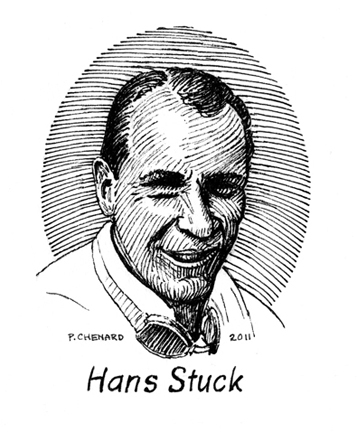
From race start, a battle developed between the leader, Auto Union driver Hans Stuck, and Mercedes driver Rudolf Caracciola. They pulled away from the rest of the pack, breaking lap record after lap record. 

Caracciola manage to get by Stuck at the Karussel curve and take the lead, but the strain was too much for the Mercedes W25’s engine, forcing him to retire.

Luigi Fagioi took up the chase in his teammate’s place, with Louis Chiron driving his Scuderia Ferrari Alfa Romeo P3 in a very distant third place, ahead of Nuvolari’s Maserati.

It was a resounding first win for Stuck and the Auto Union team, with an encouraging second place for Mercedes on the especially challenging track.

Wednesday, 23 March 2011

Alfred Neubauer

Born on March 29 1901, Alfred Neubauer fell in love with the automobile as a young boy.

After WWI, he became a racecar driver for Astro-Daimler. He then moved with Ferdinand Porsche to Mercedes, where he would find his life-long professional home. By 1926, it was apparent that Neubauer was a much better manager than driver. He was soon recruiting quality drivers such Rudolf Caracciola to the team.

While manager of the race team, he brought into play various ways to communicate to the drivers during the races, such as hand signals and pit-boards, presenting them with useful information like race position, laps remaining, when to pit for fuel, etc. These communications methods have been adopted for races worldwide.

As a large man with a booming voice, Neubauer commanded attention and respect from his team and the officials. He was strict but fair on the track, and incredibly entertaining as a dinner host.
He led his team to great success before and after WWII, with Mercedes winning the Mille Miglia (1931, 1955), the Targa Florio (1955), six European and Grand Prix Championships (1935, 1937, 1938, 1954, 1955), along with wins at Le Mans (1952) and La Carrera Panamericana (1952).

Neubauer retired as race team manager in 1955, and passed away in 1980.

Wednesday, 16 March 2011

Grand Prix de France 1934

The French Grand Prix in Montlhéry, just south of Paris, signaled the return of Rudolf Caracciola with the Mercedes Team, having spent the last fourteen months recovering from a serious accident.

Auto Union was present, along with the Scuderia Ferrari Alfa Romeos and a couple of Maseratis. Tazio Nuvolari was invited to try the Bugatti Type 59 by Ettore Bugatti.

At race start, Louis Chiron driving for Scuderia Ferrari quickly took the lead from Caracciola, Luigi Fagioli (Mercedes) and Hans Stuck (Auto Union). Stuck than pushed hard past the Mercedes drivers to take the lead from Chiron.

Nuvolari experienced gearbox trouble in the Bugatti so he handed it off to Jean-Pierre Wimille. Fagioli was instructed to push harder to catch the lead cars.

The high pace of the race started taking it’s toll on the new German cars, and one by one they dropped out, Caracciola with fuel-feed problems, Fagioli with a broken brake-line, von Brauchitsch with supercharger woes, the persistent Stuck with engine problems, and Momberger with a steering break.

The other teams also dropped out, Bugatti with mostly engine and transmission issues, and Maserati with axle and engine breaks.

Trossi, Chiron and Varzi, race-ready for Scuderia Ferrari
Pen&ink, markers and pencil on white archival stock 12”x 9” (30.5cm x 22.9cm) © Paul Chenard 2010
Original sketch available, as is the limited edition.

This led to a clean sweep for the Scuderia Ferrari Alfa Romeos with Chiron first, Varzi second and the Trossi/Moll duo third.

The 80,000 spectators were thrilled with Chiron’s win over the Germans teams. This win hid the fact that all the German cars, though still being very new, fell out of the race for fairly minor reasons, and that with better preparation, they would have clearly matched the opposition.

Wednesday, 20 October 2010

1934 Italian Grand Prix

The Italian Grand Prix was held on September 9th at the Autodromo Di Monza. In the previous year’s Grand Prix, serious accidents had taken the lives of Giuseppe Campari and two other drivers. To lessen the speeds, it was decided that the track should be shortened from 10kms to 4.3kms, with many chicanes added in. With 500kms to cover for the Grand Prix, this made for a longer, more grueling race.

Mercedes had their W25, Bugatti their Type 59, Scuderia Ferrari the Alfa P3, while Maserati introduced the new model 6C-34, to be driven by Tazio Nuvolari. The balance of their team would drive the 8CMs.

Pen&ink, markers, and pencil on archival white stock 12”x 9” © Paul Chenard 2010
Original art & limited editions available.

At the start, Hans Stuck took an early lead for Auto Union but was soon overtaken by Mercedes driver Rudolf Caracciola. His teammate Manfred Georg Rudolf von Brauchitsch was not competing, having been injured in a crash at the previous Swiss Grand Prix. Battling amongst the leaders were Luigi Fagioli (Mercedes), Archille Varzi (Alfa Romeo), Nuvolari (Maserati) and Count Carlo Felice Trossi (Alfa Romeo).

Unfortunately for Nuvolari, the Maserati mechanics forgot to top-up his car's brake fluid after weigh-in, so he slowly lost his brakes during the long race.

The 4.75 hour race, with it’s 1600 total corners, took a toll on the drivers and the cars. Fagioli, whose car broke down, later replaced Caracciola, who had to be lifted out of his car. Stuck had to be replaced by zu Leiningen, and Trossi by Comotti.

Varzi dropped out with mechanical woes, so the race finished with Caracciola/Figioli in first place, Stuck/zu Leiningen in second, with Trossi/Comotti in third. After 4th place Chiron (Alfa Romeo), Nuvolari finished a respectable 5th place, using his gears to brake for the last half of the race.

Tuesday, 24 August 2010

Auto Union: The Other Silver Arrows

In 1933, the new German government saw the marketing benefits from motor racing, so they offered a subsidy for any automotive group who want to get into racing.

Mercedes decided to opt in, but they were not alone. A group of four automobile companies – Audi, DKW, Horch, and Wanderer – pooled their technical resources to form Auto Union.

Both companies had a car ready for the 1934 Grand Prix Season. Mercedes took the standard front engine/rear drive approach, but Auto Union created a mid-engine/rear drive racer, designed by Ferdinand Porsche.

After a bit of teething problems earlier in the season, the Auto Unions proved to be a successful, with wins growing by the end of the season.

Hans Stuck - Auto Union Type A
German Grand Prix - Nürburgring 1934

Pen&ink, markers and pencil on watercolour paper 12"x 9" (30.5cm x 22.9cm)
© Paul Chenard 2010
Original sketch available, as is the limited edition.


The total dominance of both the technologically advanced Mercedes and Auto Union teams was felt until the begin of the war.

Thursday, 28 August 2008

The Vanderbilt Cup Races


Prismacolor pencil on Neenah Classic Laid stock
© Paul Chenard 2008
Gary Faules Collection

The Vanderbilt Cup races were the brainchild of millionaire sportsman William K. Vanderbilt, Jr. in an effort to bring European style road racing to America.

Modeled in the Gordon Bennett races, the first race took place on Long Island, New York in 1904. Though it was a bit disorganized, it was a huge success. This led to a series of successful, well attended races every year until 1916. They were also run in Savannah (Georgia), Milwaukee (Wisconsin), and Santa Monica and San Francisco (California).

The Vanderbilt Cup races returned off and on, in various forms, in 1936 and 1937, in 1960, and from 1996 to 2007 but these were nothing like those early pioneer days.

My friend Gary Faules of California's Best, Inc. has written extensively on the Vanderbilt Cup races; check out his great stories:
http://thegarageblog.com/garage/?s=Vanderbilt

Enjoy!

Monday, 9 June 2008

Sir Stirling Moss OBE - a British National Treasure


Pencil on white archival stock © Paul Chenard 2007

Born on September 17, 1929, Sir Stirling Moss OBE is one of the world's premier drivers of the 1950's and early 1960's.

He excelled in all types of vehicles in all types of races
– he is often called "the greatest driver never to win the World Championship". He was successful in race and sports cars made by Aston Martin, Cooper, Ferrari, Lotus, Jaguar, Maserati, Mercedes, Sunbeam, and Vanwall.

He made history in 1955 by winning, along with his navigator, journalist Denis Jenkinson, the Mille Miglia in a record time of 10 hrs, 7 mins, 48 secs, nearly a half an hour ahead of second place Juan Manuel Fangio.

Sir Moss is now a very popular attendee and participant at vintage racing festivals around the world.

Tuesday, 1 April 2008

Grand Prix Engines from the 1950's


Talbot-Lago T26C - France
© Paul Chenard 2008


Mercedes W196 - Germany
© Paul Chenard 2008


Vanwall 2.5L - England
© Paul Chenard 2008


Maserati 250F - Italy
© Paul Chenard 2008

Pencil and Prismacolor pencil on coloured paper 12"x9"

I decided to do significant 1950's Grand Prix race car engines on paper in International Racing Colours.

The series is available as limited edition premium archival Giclee prints, 14.5'x 11' (image size 12'x 9'), signed and numbered to a limit of 100 of each. The suggested retail price is $125 USD each plus shipping/handling, or all 4 for $445 USD plus shipping/handling.

Thursday, 6 March 2008

Silver Arrows in Monaco 1937


Pencil on paper 29 cm X 23 cm © Paul Chenard 2006
Charles Feitshans Collection

Wednesday, 5 March 2008

Fangio driving the Mercedes 300 SLR at LeMans 1955


Pencil on paper, 12"x 9" © Paul Chenard 2006
Geoffrey Chenard Collection