Showing posts with label 1978. Show all posts

Thursday, 9 June 2016

1978 Canadian Grand Prix


This coming weekend, it’s the Canadian Grand Prix.

The Canadian Grand Prix first became a Formula 1 event in 1967 with the race held at Mosport Park near Toronto, Ontario. Through the late 1960’s and the early 1970’s the race was shared between Mosport Park and the Circuit Mont-Tremblant in Québec.


As speeds built up, it was felt the Mosport and Mont-Tremblant were not safe enough, so for 1978, a new Formula 1 track was built in Montréal called Circuit Île Notre-Dame on the island of Notre-Dame.
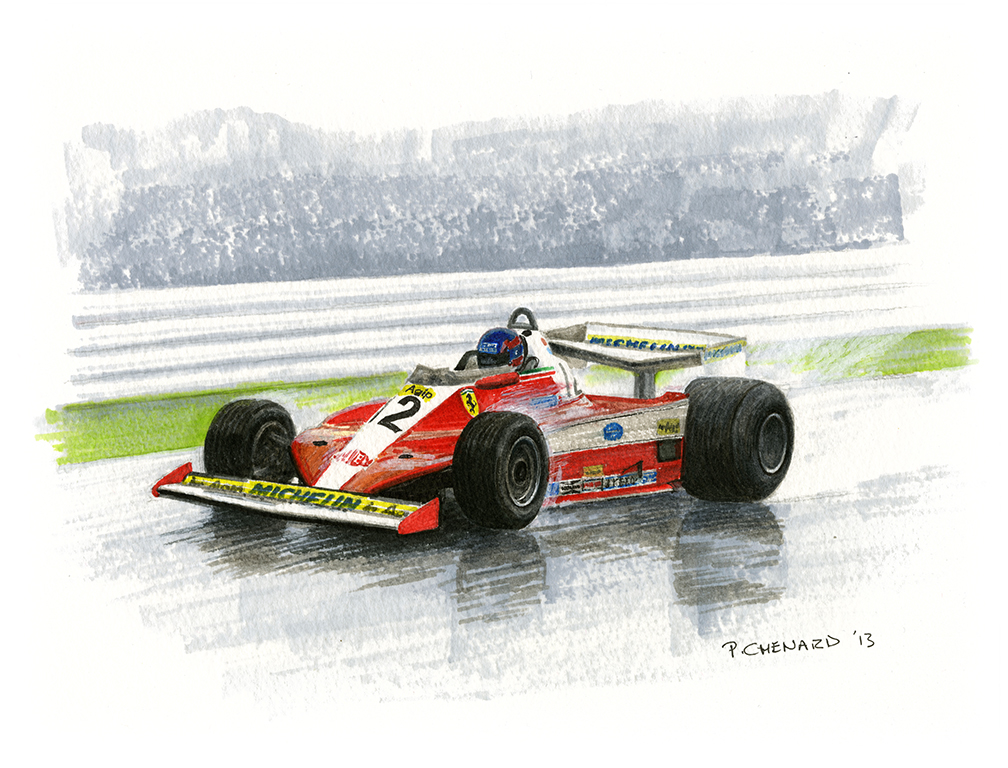

Pen&ink and markers on 11.5"x 9" watercolour paper

© Paul Chenard 2013


For that inaugural race, Canadian driver Gilles Villeneuve, along with teammate Carlos Reutermann, were there racing Ferrari T3’s for Scuderia Ferrari.

Cold and wet weather greeted the teams for practice and qualifying on Friday and Saturday, and Villeneuve managed to get his car to 3rd place on the starting grid behind Jean-Pierre Jarier (Lotus) and Jody Scheckter (Wolf).

The rain was gone for race day, but it was bitterly cold and cloudy, not ideal racing conditions. Villeneuve stayed with the leaders from the start, and as they dropped out he moved up to take the lead, driving in a smooth and steady way.

He went on to win his first Grand Prix race in front of the home crowd on the new track, a real storybook ending!

After Gilles Villeneuve’s passing in 1982, the track was renamed Circuit Gilles Villeneuve in his honour.

Monday, 1 July 2013

Mike “The Bike” Hailwood

Mike Hailwood was a popular British racer, racing in both Formula 1 motorcycles and cars.

Born in 1940, son of a motorcycle dealer and racer, Hailwood quickly learned the business. He also started racing motorcycles in 1957, and by 1958, he was winning races.

In 1961, racing for Honda, he actually won in 3 different classes of the Isle of Mann TT, all in the same weekend! He won the 250cc World Championship that year.

For 1962, he moved to MV Agusta, and won 4 consecutive 500cc World Championships.

Returning to Honda for 1966, he again won titles in both the 250cc and 350cc classes, repeating it again for 1967.

Honda stepped out of Grand Prix motorcycle racing for 1968, and paid Hailwood not to go to another team, hoping to have him back when they returned.

He instead took up automobile racing, starting in sports/GT, moving to Formula 2, where he earned the 1972 European title. He moved into Formula 1, but retired after being badly injured in major crash during the 1974 German Grand Prix at the Nürburgring.

He married Pauline Barbara Nash in 1975 and they had two children, a son David and daughter Michelle.


Pen&ink and paint markers on red archival stock
© Paul Chenard 2013


In 1978, a full 11 years after stopping, he returned to motorcycle racing in a stunning way, famously winning the Isle of Mann TT in a Ducati 900SS.

He retired completely from racing in 1979, and opened a motorcycle dealership. Tragically, the well-liked racer was killed with his daughter in a 1981 motor vehicle accident when a truck made an illegal turn and pull out in front of them.

Monday, 23 February 2009

Super Swede Ronnie Peterson - Lotus 72E - 1973 Italian Grand Prix, Monza

Watercolour pencils and marker of archival stock, 12"x 6"
© Paul Chenard 2009

This illustration is available for sale.

Swedish Formula 1 driver Ronnie Peterson was one of the few in Formula 1 who was liked and appreciated by all those who met him.

He was quiet, shy and an all-round nice guy. But once in a race car, he drove flat-out, pushing his cars often past their limit.

He started successfully in karts, rose through F3, and F2, and quickly caught the notice of the Formula 1 teams.

He started with March, moved to Lotus, March again, then Tyrrell, than finally back to Lotus. He had a total of 10 Grand Prix wins in eight years, but his life came to an abrupt and sad end in a crash while driving a Lotus 78 in the 1978 Italian Grand Prix.

The impact of the death of this much-loved driver can be seen even today, with countless of tributes set up on websites, and a museum dedicated in his memory in Örebro, Sweden.