Showing posts with label Formula 1. Show all posts

Tuesday, 3 April 2018

Ayrton Senna da Silva

In each time-period of Grand Prix racing, there are stars that shine brighter than others … Nuvolari in the 1930’s, Fangio in the 1950’s, Clark in the 1960’s, and so on ...

In the late 1980’s/early 1990’s, Formula 1’s brightest star was Brazilian driver Ayrton Senna.

Born on March 21st, 1960, Senna started racing karts at a young age, then moved into open-wheeled Formula 3, winning the 1983 British Formula 3 Championship.


He entered Formula 1 in 1984, driving for Toleman-Hart, before moving to Lotus-Renault for 1985 and winning his first race in the Lotus 97T at the rainy Portuguese Grand Prix.


After his three seasons with Lotus, in 1988 he moved to McLaren, joining teammate Frenchman Alain Prost.


A very strong rivalry developed between Prost and Senna, yet Senna won 8 of 16 races in the McLaren MP4/4, and took the Formula 1 Driver’s Championship. This, combined with Prost’s 7 wins, gave McLaren their 4th Constructors’ Championship.


Senna stayed with the McLaren team through to the end of 1993, winning 2 more Championships (1990, 1991) before moving to the Williams team for 1994.

The 3rd race of the 1994 season was held in San Marino. Sadly, in the Saturday practice session, Austrian driver Roland Ratzenberger died in the crash of his Simtek-Ford.

During the Sunday May 1st race, Senna crash his Williams, hitting the wall very hard on the 7th lap, and never regained consciousness.


The legend was no more …

Saturday, 3 February 2018

Ferrari – A Heritage of Racing

Any automotive racing history artist documenting racing history through their art will be asked why there are so many Ferrari subjects featured.


A quick look at the Formula 1 history quickly explains the reason; Ferrari has been the Formula 1 Constructors Champion for a total of 16 times!!


The 2nd most wins comes from the Williams Team with 9 Constructors titles.


Ferrari also dominated sports/GT racing from the late 1940’s into the mid-1960’s.


Enzo Ferrari’s passion for racing is well-documented; his primary reason for selling road cars was the finance his racing endeavours.


That Ferrari passion runs deep in the hearts of us automotive artists too!!
-->

Friday, 9 June 2017

Le Grand Prix de Monaco

The Grand Prix de Monaco is still going strong since that first race in 1929.

There is none other like it in the world, a high speed race through a historic city center, with changes in elevation, sharp corners, and no place to pass!

With glamorous coastal setting, facing the turquoise waters of the Ligurian Sea, this playground for the ultra-rich on the French Riviera has been on the must-win wish-list of many, if not all, the Grand Prix drivers.


William Grover in a factory Bugatti Type 35B won that 1929 race.


Bugattis, followed up by Alfa Romeos, dominated the early years; Mercedes finished up the pre-war years.


Italian cars, Maserati, Alfa Romeo and Ferrari won in the early post-war years, then the British Lotus, Cooper, BRM and Tyrrell teams dominated till the mid-1970’s.


Ferrari would come back, mixed in with wins by Wolf, Williams, Brabham, Benetton, Ligier, Renault, Brawn, Red Bull, Mercedes, and many by McLaren.


And Ferrari has now won their first in 16 years!!

Racing the current wide-track Formula 1 cars through the somewhat garish streets of Monaco is borderline ridiculous but at the same time, that’s the beauty of it. It’s the only remaining unchanged race track of the Formula 1 circuits (or should I say circus?) so the drivers are following in the tracks of history, of the greatness of the past exploits.

Nothing can beat that …

Thursday, 9 June 2016

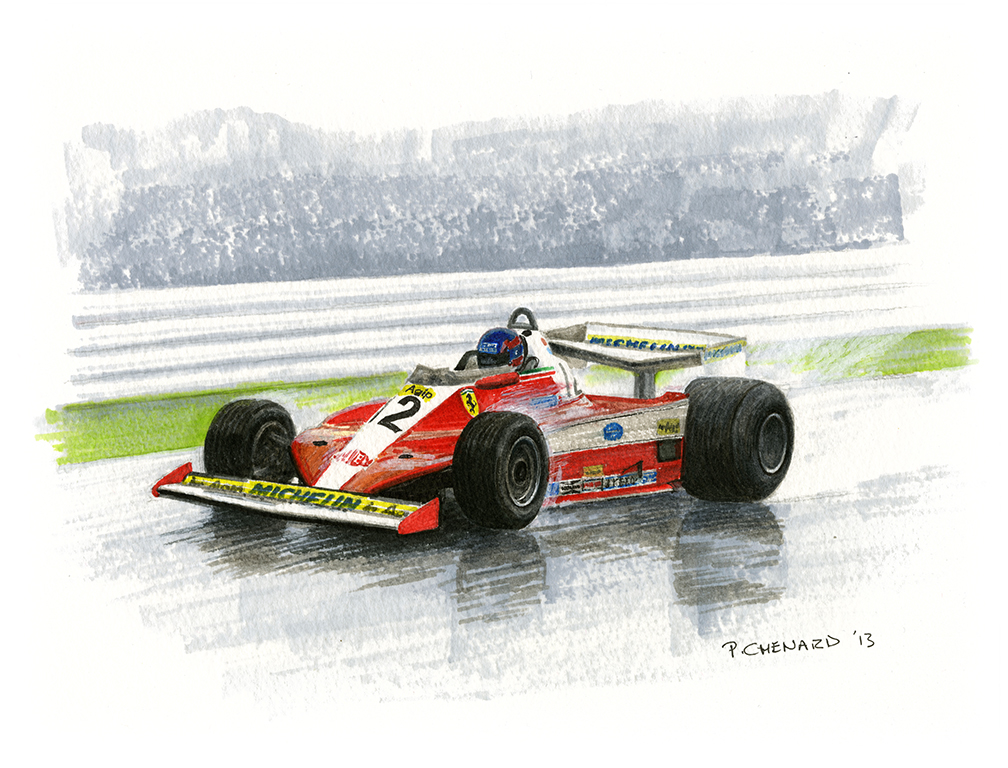
1978 Canadian Grand Prix


This coming weekend, it’s the Canadian Grand Prix.

The Canadian Grand Prix first became a Formula 1 event in 1967 with the race held at Mosport Park near Toronto, Ontario. Through the late 1960’s and the early 1970’s the race was shared between Mosport Park and the Circuit Mont-Tremblant in Québec.


As speeds built up, it was felt the Mosport and Mont-Tremblant were not safe enough, so for 1978, a new Formula 1 track was built in Montréal called Circuit Île Notre-Dame on the island of Notre-Dame.


Pen&ink and markers on 11.5"x 9" watercolour paper

© Paul Chenard 2013


For that inaugural race, Canadian driver Gilles Villeneuve, along with teammate Carlos Reutermann, were there racing Ferrari T3’s for Scuderia Ferrari.

Cold and wet weather greeted the teams for practice and qualifying on Friday and Saturday, and Villeneuve managed to get his car to 3rd place on the starting grid behind Jean-Pierre Jarier (Lotus) and Jody Scheckter (Wolf).

The rain was gone for race day, but it was bitterly cold and cloudy, not ideal racing conditions. Villeneuve stayed with the leaders from the start, and as they dropped out he moved up to take the lead, driving in a smooth and steady way.

He went on to win his first Grand Prix race in front of the home crowd on the new track, a real storybook ending!

After Gilles Villeneuve’s passing in 1982, the track was renamed Circuit Gilles Villeneuve in his honour.

Tuesday, 4 March 2014

Matra goes Racing

In the 1960’s, the French high-tech company Matra decided to start building racing cars as a way to promote their capabilities in a very public way.

They started designing and building Formula 3 and Formula 2 cars which relied on Matra’s knowledge of aeronautics and aircraft building methods.

These new racers quickly met with success, which encouraged Matra in 1968 to after the top level of racing, Formula 1.

With Scottish driver Sir Jackie Stewart at the wheel, they took 3 races in the season.


Pen&ink and markers on blue archival paper
© Paul Chenard


For 1969, they introduced a new car, and Stewart took the Championship.

With this first mission accomplished, they expanded into sports car racing, with the goal of winning at the 24 heures du Mans and the World Championship for Makes.


Latex house paint on oak plywood
© Paul Chenard


They won at Le Mans in 1972, 1973, and 1974, and took the Championship for 1973 and 1974. Driving home those 3 wins was French driver Henri Pescarolo, partnered with Graham Hill (Great Britain) the first year in a Matra MS670, and Gérard Larousse (France) for the next two, diving the Matra MS670B, then the MS670C.


Pen&ink and markers on watercolour paper
© Paul Chenard


After 1974, they stopped building racecars, and instead focused on racecar engine development and design.

Monday, 1 July 2013

Mike “The Bike” Hailwood

Mike Hailwood was a popular British racer, racing in both Formula 1 motorcycles and cars.

Born in 1940, son of a motorcycle dealer and racer, Hailwood quickly learned the business. He also started racing motorcycles in 1957, and by 1958, he was winning races.

In 1961, racing for Honda, he actually won in 3 different classes of the Isle of Mann TT, all in the same weekend! He won the 250cc World Championship that year.

For 1962, he moved to MV Agusta, and won 4 consecutive 500cc World Championships.

Returning to Honda for 1966, he again won titles in both the 250cc and 350cc classes, repeating it again for 1967.

Honda stepped out of Grand Prix motorcycle racing for 1968, and paid Hailwood not to go to another team, hoping to have him back when they returned.

He instead took up automobile racing, starting in sports/GT, moving to Formula 2, where he earned the 1972 European title. He moved into Formula 1, but retired after being badly injured in major crash during the 1974 German Grand Prix at the Nürburgring.

He married Pauline Barbara Nash in 1975 and they had two children, a son David and daughter Michelle.


Pen&ink and paint markers on red archival stock
© Paul Chenard 2013


In 1978, a full 11 years after stopping, he returned to motorcycle racing in a stunning way, famously winning the Isle of Mann TT in a Ducati 900SS.

He retired completely from racing in 1979, and opened a motorcycle dealership. Tragically, the well-liked racer was killed with his daughter in a 1981 motor vehicle accident when a truck made an illegal turn and pull out in front of them.

Wednesday, 8 May 2013

Gilles Villeneuve – 31 Years Ago …

31 years ago today, Formula 1 lost one of its most impassioned and exciting drivers, one we will never forget …


“… in equal cars – or sometimes in a lesser car – when I want someone to stay behind … I think he stays behind.”

Saturday, 14 January 2012

Richie Ginther: The Race Car Developer

Paul Richard “Richie” Ginther was born in Granada Hills, California in 1930.

He was raised in the same town as Phil Hill, and worked for Douglas Aircraft in the tool and die shop. Ginther met Hill and helped him in the repair and maintenance of his race cars.

He started his own race career in 1951, driving a Ford-powered MG. Shortly afterward, he was drafted to the Korean war, and worked on aircraft maintenance. 
Page from the 1959 Fuller Brush catalog.

Once out of the military, Ginther was drafted by Hill as his riding mechanic for the 1953 Carrera Panamericana, racing in a Ferrari 340 Mexico Vignale. They ran well until they left the road and severely damaged the Ferrari. They returned the following year, racing a Ferrari 375 MM Vignale and finished in second place.

Page from the 1959 Fuller Brush catalog.

Not long after Hill left for Europe to drive for Scuderia Ferrari, and Ginther took his place in the States, racing more and more frequently, gaining successes.

He drove Healeys, Porsches, Aston Martins, and finally Ferraris. He moved to Europe, joining Hill with Ferrari, where he stayed for the 1960 and 1961 seasons. He was instrumental in the race development of the famous 156 F1 “Sharknose”.

Sharknoses at Spa 1961, where Ginther finished in 3rd place. Pen&ink, pencils and markers on white archival stock 12"x 9" © Paul Chenard 2012


From there he moved to BRM for 1962, also helping in the development of their Championship-winning P57 Formula 1 car.

Tamiya 1/20 Honda RA272 kit that I built.

He joined Honda in 1965, racing their new RA272 F1 car. In the last Grand Prix of the season in Mexico, he won the race, giving Honda and Goodyear their first Formula 1 win. Unfortunately, it was Ginther’s only Formula 1 win.

Sketch on a package I shipped to California for a good client.
Pen&ink and markers on Foamcore.  © Paul Chenard 2012

Ginther had a small part in John Frankenheimer’s 1966 film “Grand Prix.”

Ginther finally retired in 1967, and sadly passed away in 1989 while camping with his family in France.

Tuesday, 23 August 2011

Phil Hill – America's First Formula 1 World Drivers’ Champion

This year we celebrate the 50th anniversary of Phil Hill’s Formula 1 World Drivers’ Championship.

1961 Formula 1 World Drivers' Champion Phil Hill and the Ferrari 156 F1 "Sharknose"
Pen& ink and Prismacolor pencils on white archival stock 
© Paul Chenard 2011
Available as a limited edition of 50.


50 years ago, there were more Americans involved in Formula 1; Phil Hill was joined by Dan Gurney and Richie Ginther in high echelons of international racing, and more were to follow.


Hill made his mark successfully racing sports cars, including Ferraris. This got the attention of the man himself, Mr. Ferrari, and Hill was recruited to the team. He started racing in Formula 1 in 1958, finally winning his first race in 1960 at the Italian Grand Prix at Monza.

The following year, he took the Championship, racing the famous Ferrari 156 F1 “Sharknose”.

Phil Hill’s accomplishment is being celebrated at the Danville Tours D’Élégance on September 17th and 18th. Please try to attend this wonderful event; proceeds from it will go in support of Parkinson’s research and patient care.

I’ve had the honour of designing the poster for the event; Phil Hill is one of my heroes, too!

Friday, 24 June 2011

Juan Manuel Fangio - El Maestro

Today marks the 100th anniversary of Juan Manuel Fangio's birth. This five-time Formula 1 Drivers' World Champion from Balcarce, Argentina passed away on July 17, 1995.

¡Feliz cumpleaños, El Maestro!

Thursday, 19 May 2011

Sir Moss takes Monaco 1961

50 years ago on the last weekend in May, everything pointed to a possible Ferrari sweep of the Grand Prix de Monaco.

Ferrari had introduced their new Formula 1 contender the 156 “Sharknose”, which carried a distinct horsepower advantage over the competition.

Ferrari was running two engine configurations; a V-6 with a 65 degree V-angle (180 hp) and one with a 120 degree V-angle (190 hp). Phil Hill and Wolfgang von Trips raced 65 degree V-6’s and Richie Ginther the 120 degree V6.

Sir Stirling Moss - Winner, Monaco Grand Prix 1961
Prismacolor pencils on gray archival stock, 10"x 8"  © Paul Chenard 2009
Private collection. Available as a limited edition.


Sir Stirling Moss was driving the Rob Walker Lotus 18 F1 car which ran with a 1.5 litre Climax inline-4 engine producing only 174 hp.

Lotus was also there with Jim Clark driving the Lotus-Climax, with Jo Bonnier and Dan Gurney racing the Porsche 718’s.

From his pole position, Sir Moss took an early lead from Ginther and Clark, and retained it to the end. He drove at 10/10’s for the whole race, keeping just ahead of the very persistent Ginther and Hill in their more powerful cars.

Sir Moss is quoted in saying that this was his best race ever, and in seeing the machines and talent he was up against, one can only agree!

Thursday, 5 May 2011

Juan Manuel Fangio 1911-1995

This year marks the 100th anniversary of the birth 
of Juan Manuel Fangio.
Limited edition archival Giclee print
Edition of 100 - Signed/numbered - 11"x 17" (28cm x 43cm)
$125 USD plus shipping
© Paul Chenard 2011

Many, including myself, consider this Argentinian racer as the greatest driver of the post-war era.

Born in Balcarce in 1911 to Italian immigrants, Fangio started racing in 1934, driving a Ford Model A that he built. He later raced long-distance road races driving a Chevrolet to success, becoming Argentine National Champion in 1940 and 1941.

In 1948, he went racing in Europe, capturing a few wins, and the notice of the Grand Prix teams. He was hired by Alfa Romeo in 1950, and finished 2nd in the Championship. In 1951, he won his first of five Formula 1 World Drivers’ Championships, again driving for Alfa Romeo. He finished 2nd again in 1953 with Maserati.

In 1953, he also won the La Carrera Panamericana, driving a Lancia D24.

In 1954, he started with Maserati, winning two races, then switched to Mercedes, and won four more races, taking his second Championship.

He won again in 1955, driving for Mercedes, in 1956, driving for Ferrari , and in 1957, driving again with Maserati.


His most famous win came in the 1957 German Grand Prix at the Nürburgring, where he beat a strong Ferrari opposition, driving the famous Maserati 250F. At the same time, he established a new track record.

He retired to Argentina in 1958 at the age of 47. He made countless guest appearances at many automotive events worldwide, and even appeared as himself in John Frankenheimer’s film “Grand Prix”.

The Juan Manuel Fangio Museum opened in Balcarce in 1986. This fine gentleman racer died in 1995 in Buenos Aires at the age of 84.

Thursday, 28 April 2011

Ferrari 156 “Sharknose” 50th Anniversary

This year marks the 50th anniversary of Ferrari's first rear-engined Formula 1 car, the famous 156 “Sharknose”. It was so named because of the distinctive air intake “nostrils” on either side of the front of the racer.

Battle Plans 1961 Black and white pen&ink (14"x 11), digitally painted, available as a limited edition.
© Paul Chenard 2010
The 156 was designed by Carlo Chiti, and was powered by a 1,476 cc V6 “Dino” engine.

The car was driven to success by such notable drivers as Phil Hill, Wolfgang von Trips, Richie Ginther, Giancarlo Baghetti, Ricardo Rodríguez, Lorenzo Bandini, Willy Mairesse and John Surtees.

Belgian Grand Prix 1961 - "Sharknoses" Limited edition of 50 – 14.5”x 11” (36.8 cm x 27.9 cm) – $150 USD plus S/H
American Phil Hill won the Formula 1 World Drivers’ Championship driving the “Sharknose”, with a win at the Belgian and Italian Grands Prix, and podium finishes in Monaco, Nederlands, Great Britain and Germany.


Black & white pen&ink (22"x 17), digitally painted, available as a limited edition signed by Phil Hill.
© Paul Chenard 2007
Sadly, all the “Sharknose” F1 Ferraris were scrapped after the 1963 season, but a few replicas have since been constructed.

Wednesday, 23 March 2011

Alfred Neubauer

Born on March 29 1901, Alfred Neubauer fell in love with the automobile as a young boy.

After WWI, he became a racecar driver for Astro-Daimler. He then moved with Ferdinand Porsche to Mercedes, where he would find his life-long professional home. By 1926, it was apparent that Neubauer was a much better manager than driver. He was soon recruiting quality drivers such Rudolf Caracciola to the team.

While manager of the race team, he brought into play various ways to communicate to the drivers during the races, such as hand signals and pit-boards, presenting them with useful information like race position, laps remaining, when to pit for fuel, etc. These communications methods have been adopted for races worldwide.

As a large man with a booming voice, Neubauer commanded attention and respect from his team and the officials. He was strict but fair on the track, and incredibly entertaining as a dinner host.
He led his team to great success before and after WWII, with Mercedes winning the Mille Miglia (1931, 1955), the Targa Florio (1955), six European and Grand Prix Championships (1935, 1937, 1938, 1954, 1955), along with wins at Le Mans (1952) and La Carrera Panamericana (1952).

Neubauer retired as race team manager in 1955, and passed away in 1980.