
For 1966, Lotus raced their 33 with both a Climax V8 and BRM V8 and H16 engines, with poor results. They also raced their model 43 BRM to one win.
In the background, Lotus Team owner Colin Chapman was busy convincing the Ford Motor Company to finance the design and build of a new 3 liter V8. Cosworth Engineering Ltd, a successful racing engineering company created by Mike Costin and Frank Duckworth, was commissioned to undertake the new design.

The Ford Cosworth married to the Lotus 49 chassis
As in their model 43, Lotus wanted to design the chassis with the engine as a load-bearing structure carrying the rear suspension. Colin Chapman and fellow designer Maurice Phillipe worked very closely in parallel with Cosworth to assure the success of this approach.

Colin Chapman waits as the mechanics prep the new Lotus 49 for it's first race.
The new Ford Cosworth DFV V8 was introduced in late April 1967, and the Lotus/Cosworth engineering worked hard to have the engine/chassis package ready for it race introduction at the Dutch Grand Prix held at Zandvoort on June 4.

Jim Clark on his way to winning the 1967 Dutch Grand Prix in the new Lotus 49.
Lotus driver Graham Hill easily won pole position, with fellow driver Jim Clark started in 8th place on the grid. As the race started, Hill quickly pulled away from the pack, holding the lead till his engine gave up. In the meantime, Clark moved up through the cars to take on the lead and win the race! An astonishing debut for a new car!
Unfortunately, the engine and chassis were not without their little gremlins, which allowed Denny Hulme racing the Brabham Repco to take the Championship.
For the 1968 season, the de-bugged package did it’s magic, with Graham Hill rallying the team after Jim Clack’s death in an F2 race and taking the Championship for Lotus in the 49B.
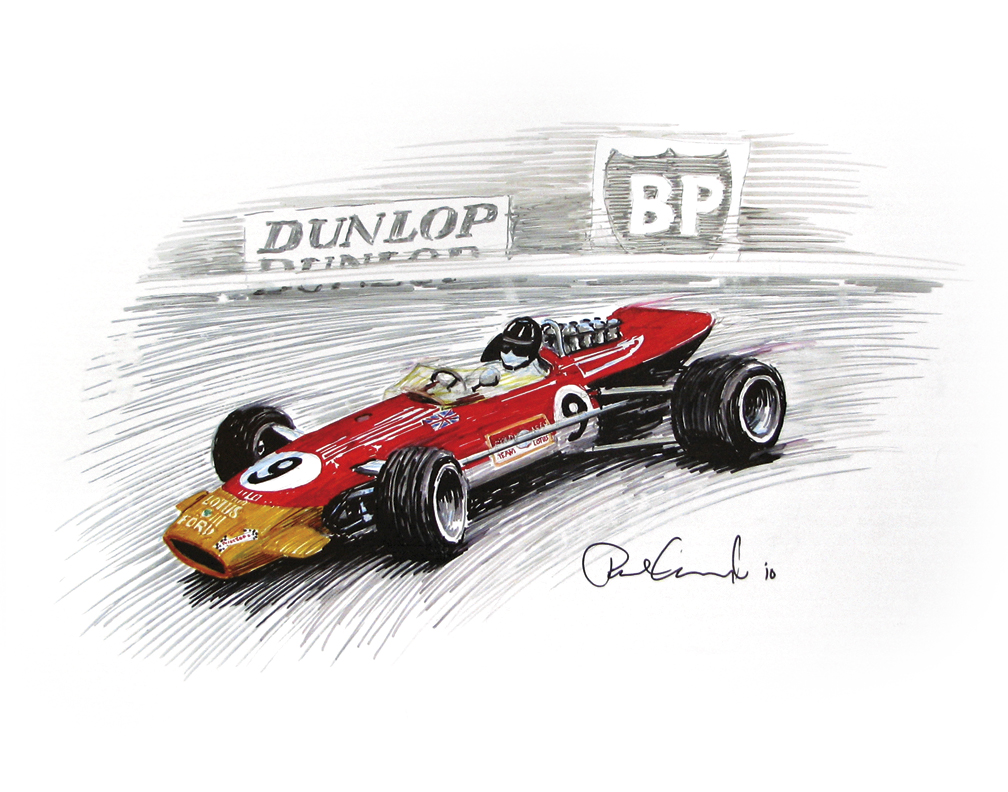
Graham Hill on his way to winning the 1968 Grand Prix de Monaco in the 49B.
Interestingly for 1968, Lotus’ Team no longer carried British racing green, but instead the sponsorship colours of Gold Leaf cigarettes, a step that would change the face of Formula 1 sponsorship, and the car’s colours …











 Posts
Posts


