Showing posts with label Jim Clark. Show all posts

Friday, 7 April 2017

Lotus Ford Cosworth 49

As Formula 1 engine capacity rules changed from 1.5 liters to 3 liters (or 1.5 liters compressed) for the 1966-1986 seasons, a few manufacturers were left scrambling for suitable power plants.

For 1966, Lotus raced their 33 with both a Climax V8 and BRM V8 and H16 engines, with poor results. They also raced their model 43 BRM to one win.

In the background, Lotus Team owner Colin Chapman was busy convincing the Ford Motor Company to finance the design and build of a new 3 liter V8. Cosworth Engineering Ltd, a successful racing engineering company created by Mike Costin and Frank Duckworth, was commissioned to undertake the new design.


The Ford Cosworth married to the Lotus 49 chassis

As in their model 43, Lotus wanted to design the chassis with the engine as a load-bearing structure carrying the rear suspension. Colin Chapman and fellow designer Maurice Phillipe worked very closely in parallel with Cosworth to assure the success of this approach.


Colin Chapman waits as the mechanics prep the new Lotus 49 for it's first race.

The new Ford Cosworth DFV V8 was introduced in late April 1967, and the Lotus/Cosworth engineering worked hard to have the engine/chassis package ready for it race introduction at the Dutch Grand Prix held at Zandvoort on June 4.


Jim Clark on his way to winning the 1967 Dutch Grand Prix in the new Lotus 49.

Lotus driver Graham Hill easily won pole position, with fellow driver Jim Clark started in 8th place on the grid. As the race started, Hill quickly pulled away from the pack, holding the lead till his engine gave up. In the meantime, Clark moved up through the cars to take on the lead and win the race! An astonishing debut for a new car!

Unfortunately, the engine and chassis were not without their little gremlins, which allowed Denny Hulme racing the Brabham Repco to take the Championship.

For the 1968 season, the de-bugged package did it’s magic, with Graham Hill rallying the team after Jim Clack’s death in an F2 race and taking the Championship for Lotus in the 49B.
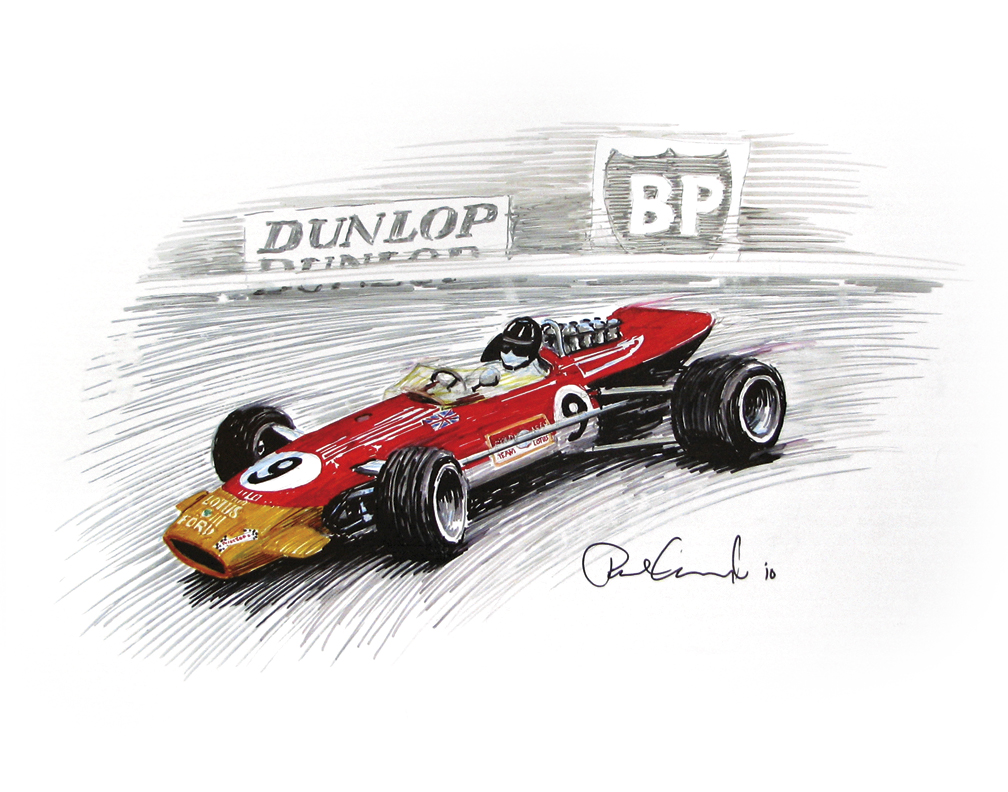

Graham Hill on his way to winning the 1968 Grand Prix de Monaco in the 49B.

Interestingly for 1968, Lotus’ Team no longer carried British racing green, but instead the sponsorship colours of Gold Leaf cigarettes, a step that would change the face of Formula 1 sponsorship, and the car’s colours …


Thursday, 11 April 2013

The Lotus 25

This year marks the 50th anniversary of the iconic Lotus 25 Formula 1 race car's Championship win.


Colin Chapman's fertile mind created it as the first effective monocoque chassis racer.


He introduced it in 1962, and in the hands of Jim Clark, it nearly took the Championship, losing out in the end to Graham Hill in the BRM P57.


For 1963, Clark drove the Lotus 25 to the first of his two World Drivers’ Championships, easily taking 7 of the 10 races.


Pen&ink and Prismacolor pencils on white archival stock
© Paul Chenard 2013


With its sleek lines and wonderful proportions, the Lotus 25 is considered by many as one of the most beautiful race cars ever made.

I can’t really disagree … especially with that lovely paint job!

Wednesday, 28 March 2012

Team Lotus wins the 1965 Indianapolis 500

In 1962, Dan Gurney invited Colin Chapman as his guest at the Indianapolis 500 to show him the potential of bringing a Lotus race car there to compete.

Chapman was impressed and decided to give it a go with his rear-engine racers.

For 1963, Team Lotus raced a Lotus 29, and came very close to winning with Jim Clark driving. They came back in 1964 with the Lotus 34, but tire problems sidelined the cars.


Jim Clark - Lotus 38 - 1965 Indianapolis 500


Pen&ink, paint markers and markers on green archival paper
© Paul Chenard 2012
Private commission - Available as a limited edition

In 1965, they came back, this time with the lovely Ford-powered Lotus 38.

Clark went on to lead all but 10 of the full 200 laps, averaging a new record speed of over 150 miles-per-hour (241 kph), coming in to win with an amazing margin of victory of just under 2 minutes.

It was a first Indianapolis 500 win for Jim Clark, Lotus Racing and the Ford Motor Company. It also broke the long-standing curse of bad luck racing a green race car at the Indianapolis 500.

Significantly, it was the first win there for a rear-engine car, spelling the end of traditional front-engine roadster.

Thursday, 19 May 2011

Sir Moss takes Monaco 1961

50 years ago on the last weekend in May, everything pointed to a possible Ferrari sweep of the Grand Prix de Monaco.

Ferrari had introduced their new Formula 1 contender the 156 “Sharknose”, which carried a distinct horsepower advantage over the competition.

Ferrari was running two engine configurations; a V-6 with a 65 degree V-angle (180 hp) and one with a 120 degree V-angle (190 hp). Phil Hill and Wolfgang von Trips raced 65 degree V-6’s and Richie Ginther the 120 degree V6.

Sir Stirling Moss - Winner, Monaco Grand Prix 1961
Prismacolor pencils on gray archival stock, 10"x 8"  © Paul Chenard 2009
Private collection. Available as a limited edition.


Sir Stirling Moss was driving the Rob Walker Lotus 18 F1 car which ran with a 1.5 litre Climax inline-4 engine producing only 174 hp.

Lotus was also there with Jim Clark driving the Lotus-Climax, with Jo Bonnier and Dan Gurney racing the Porsche 718’s.

From his pole position, Sir Moss took an early lead from Ginther and Clark, and retained it to the end. He drove at 10/10’s for the whole race, keeping just ahead of the very persistent Ginther and Hill in their more powerful cars.

Sir Moss is quoted in saying that this was his best race ever, and in seeing the machines and talent he was up against, one can only agree!

Sunday, 21 February 2010

Making 3D out of 2D …

The Lotus 49 was another of a long line of brilliant Colin Chapman (and Maurice Phillipe) designs, being the first Formula 1 racecar to successfully use the motor as a stress-bearing structural member.

Jim Clark won 4 races in 1967 driving the Lotus 49, and the first race of the 1968 season before being tragically killed in an F2 race in Hockenheim.

I decided to illustrate a "faux" 1967 Silverstone poster, done in the old mid '60s British style.

In the sketch, Clark leads 2nd place finisher Denny Hulme in his Brabham BT24, followed by 3rd place Chris Amon in his Ferrari 312 F1.

As an experiment, I wanted to render a normally 2D sketch into 3D. To create the 3D illusion, I had to illustrate the cars in parts, and then assemble the parts onto the illustrated background.

For example, the Clark Lotus 49 is built from 9 separate illustrations, cut out, and assembled in layers to create a "trompe l'oeil". The 3 cars are done like that, and positioned into their 1st, 2nd, and 3rd race finishing order. The "Silverstone" text is also cut out paper ...

Prismacolor pencils on individual coloured papers, cut out and layered onto background

© Paul Chenard 2010

Marc Hogenkamp Collection

Commissions are available.

Friday, 13 March 2009

Aston Martin DB4 GT Zagato: “Machismo” defined

After they introduced their stunning new Touring-bodied DB4 GT in 1959, Aston Martin decided to take on Ferraris SWB 250GTs with their own weapon.


Pen & ink and Prismacolor pencils on Canson green archival stock
© Paul Chenard 2009

They commissioned the Milanese firm of Zagato to make their new car competitive. Young designer Ercole Spada penned a fabulous lightweight “Superleggera” body, “super-light” in Italian, which refers to a Touring-developed construction method of a frame of small-diameter metal tubes built on the main chassis, and covered with aluminum body panels.

The car is a stunning purposeful-looking racer; Doug Nye described it as "a man's car" in his 1982 Salon feature review in Road & Track magazine. It is beautiful from every angle ... rolling sculpture.

Though the Zagato was slightly lighter the original DB4 GT, they were not competitive enough to beat the all-conquering Scuderia Ferrari, which introduced the GTO. They were raced by such famous drivers as Roy Salvadori and Jim Clark.

19 of the Zagatos were built originally, and in 1991, Aston Martin authorized the building of 4 more DB4 GT Zagatos, utilizing unutilized chassis numbers; these were labeled as Sanction II cars. The original cars rarely come up for sale, but if they did, the expected sale price would be at least $3 million USD.

Monday, 16 June 2008

John Surtees OBE


Prismacolor pencils on gray archival stock 22.5"x 11"
© Paul Chenard 2008

John Surtees, the only person to win World Championships on both two (1956) and four wheels (1964), was awarded the Order of the British Empire (OBE) on the weekend, for his services to motor sports and charity.

Though it is wonderful that his great accomplishments are being recognized, I do believe that "Big John" Surtees is deserving of a higher level of recognition.

In the above sketch, Jim Clark is racing a Lotus 33 to a win of the closely fought Solitude F1 race in 1964. Left to right, we find Clark, second place finisher John Surtees in a Ferrari 158, Graham Hill in a BRM P261 and Sir Jack Braham in a Brabham BT7-Climax; both Hill and Brabham crashed out in the race. John Surtees finished the year as F1 Driver's World Champion with Ferrari.

In fact, everyone represented here was a Driver's World Champion. John Surtees took it 1964 , Clark took it in 1963 and 1965, Hill took it in 1962 and 1968, and Brabham took it in 1959, 1960 and 1966. Brabham also took it as a Constructor in 1966 and 1967. Lots of talent in one place!

Mr Surtees was kind enough to send me a comment on my illustration:

Dear Paul,

Yes a nice little piece of history. While it was very wet I of course had taken the lead and pulled away, it was only when the track started to dry up that Jim caught me. But of course I got my own back at the following race, the German GP, which I won.

Kind regards,

John

John Surtees


Available as a limited edition of 100 signed and numbered 22" x 11.25" premium archival Giclee prints for $150 plus S&H. (Includes the above quote from John Surtees O.B.E.)

Monday, 19 May 2008

Jim Clark - Solitude 1964


Prismacolor pencils on gray archival stock 22.5"x 11"
© Paul Chenard 2008


Jim Clark died tragically 40 years ago this year.
He crashed in an F2 race at the Hockenheimring in Germany in a Lotus 48.

In this sketch, Jim Clark is racing a Lotus 33 to a win of the Solitude F1 race in 1964. Left to right, we find Clark, second place finisher John Surtees in a Ferrari 158, Graham Hill in a BRM P261 and Sir Jack Braham in a Brabham BT7-Climax. Both Hill and Brabham crashed out in the race; Surtees finished the year as F1 Driver's World Champion. In fact, everyone here was a Driver's World Champion. Clark took it in 1963 and 1965, Hill took it in 1962 and 1968, and Brabham took it in 1959, 1960 and 1966. Brabham also took it as a Constructor in 1966 and 1967. Lots of talent in one place!

The following poster advertised the race ... beautiful artwork!