Showing posts with label Grand Prix. Show all posts

Friday, 9 June 2017

Le Grand Prix de Monaco

The Grand Prix de Monaco is still going strong since that first race in 1929.

There is none other like it in the world, a high speed race through a historic city center, with changes in elevation, sharp corners, and no place to pass!

With glamorous coastal setting, facing the turquoise waters of the Ligurian Sea, this playground for the ultra-rich on the French Riviera has been on the must-win wish-list of many, if not all, the Grand Prix drivers.


William Grover in a factory Bugatti Type 35B won that 1929 race.


Bugattis, followed up by Alfa Romeos, dominated the early years; Mercedes finished up the pre-war years.


Italian cars, Maserati, Alfa Romeo and Ferrari won in the early post-war years, then the British Lotus, Cooper, BRM and Tyrrell teams dominated till the mid-1970’s.


Ferrari would come back, mixed in with wins by Wolf, Williams, Brabham, Benetton, Ligier, Renault, Brawn, Red Bull, Mercedes, and many by McLaren.


And Ferrari has now won their first in 16 years!!

Racing the current wide-track Formula 1 cars through the somewhat garish streets of Monaco is borderline ridiculous but at the same time, that’s the beauty of it. It’s the only remaining unchanged race track of the Formula 1 circuits (or should I say circus?) so the drivers are following in the tracks of history, of the greatness of the past exploits.

Nothing can beat that …

Thursday, 9 June 2016

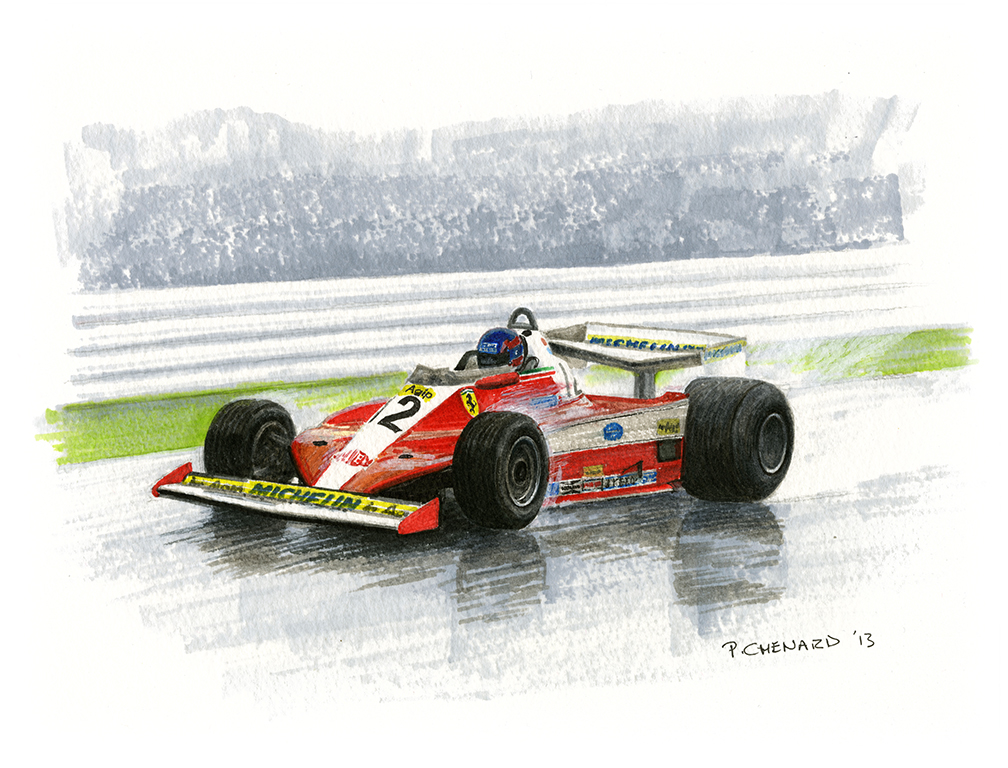
1978 Canadian Grand Prix


This coming weekend, it’s the Canadian Grand Prix.

The Canadian Grand Prix first became a Formula 1 event in 1967 with the race held at Mosport Park near Toronto, Ontario. Through the late 1960’s and the early 1970’s the race was shared between Mosport Park and the Circuit Mont-Tremblant in Québec.


As speeds built up, it was felt the Mosport and Mont-Tremblant were not safe enough, so for 1978, a new Formula 1 track was built in Montréal called Circuit Île Notre-Dame on the island of Notre-Dame.


Pen&ink and markers on 11.5"x 9" watercolour paper

© Paul Chenard 2013


For that inaugural race, Canadian driver Gilles Villeneuve, along with teammate Carlos Reutermann, were there racing Ferrari T3’s for Scuderia Ferrari.

Cold and wet weather greeted the teams for practice and qualifying on Friday and Saturday, and Villeneuve managed to get his car to 3rd place on the starting grid behind Jean-Pierre Jarier (Lotus) and Jody Scheckter (Wolf).

The rain was gone for race day, but it was bitterly cold and cloudy, not ideal racing conditions. Villeneuve stayed with the leaders from the start, and as they dropped out he moved up to take the lead, driving in a smooth and steady way.

He went on to win his first Grand Prix race in front of the home crowd on the new track, a real storybook ending!

After Gilles Villeneuve’s passing in 1982, the track was renamed Circuit Gilles Villeneuve in his honour.

Sunday, 8 December 2013

René Dreyfus - Bugatti Star

Frenchman René Dreyfus was born in Nice in 1905.


When he was 22, he convinced his mother that he needed a Bugatti to get to the clients of his paper company faster. He actually used it for racing.

He was hired as a driver by a local Bugatti dealer, and in 1929 won the Grand Prix de Dieppe in a Type 35B. His real fame came when he beat the factory team driver Chiron in the 1930 Grand Prix de Monaco.

He was briefly with the Maserati team and later joined the Bugatti factory team. With them, he won the 1934 Grand Prix de Belgique, driving a Type 59.


For 1935, he drove for Scuderia Ferrari, alongside drivers like Nuvolari and Chiron. Dreyfus had one more major win before the war, racing a Delahaye to victory at the 1938 Grand Prix de Pau.

He went to the U.S. to race in the 1940 Indianapolis 500, finishing a creditable 10th place. It became impossible to return because of World War Two, so he stayed.


He enlisted in the United States Army during the war, and at the end of it became an American citizen. He opened the famous “Le Chanteclair” restaurant in New York City in 1953, which became a gathering place for the rich and famous, and for the racers coming to the city.

Dreyfus died in New York City in 1993.

Tuesday, 30 October 2012

Mercedes-Benz W25

Until 1934, three automotive companies dominated Grand Prix racing: Alfa Romeo, Bugatti, and Maserati. Each year, these companies produced racecars that were faster and more powerful than those of the previous year.

The Association Internationale des Automobile Clubs Reconnus (AIACR), the controlling body for motor sport in the 1930s, decided to change the requirements for the 1934, 1935, and 1936 Grand Prix seasons. The most important new requirement for the racers was that the maximum weight could not exceed 750 kg, excluding driver, fuel, oil, water, and tires.

The AIACR believed that Grand Prix cars were becoming too fast and reasoned that the change in weight parameters would limit the size of the engines used.

However, the AIACR had not at all taken into consideration the possibility of the manufacturers using new technology and lightweight metallurgy to create yet more powerful, efficient racers.

Mercedes-Benz saw an opportunity to move ahead, promoting their know-how and the sale of their products through Grand Prix racing.


Luigi Fagioli on his way to winning the 1935 Grand Prix de Monaco in the Mercedes-Benz W25.

I did this sketch while waiting for my Halifax flight at gate B05 at the Montréal airport on September 24th. The guy next to me practicing on his guitar; it was great to sketch to this guy's music.

Pen&ink, paint markers and markers on gray archival stock 12"x 9" © Paul Chenard 2012

Mercedes-Benz took a traditional approach with the front-engined rear-drive racer, but also took a serious look at using innovative aerodynamics and lightweight materials to give them an advantage. A steel-blocked 3.36-litre straight-8 supercharged engine powered the new Mercedes W25, and it was wrapped in a beautiful aerodynamic aluminum skin, with all-round independent suspension.

In that first year of the new formula, they won the Coppa Acerbo, the Italian Grand Prix and the Spanish Grand Prix. For 1935, they won 9 major races, giving driver Rudolf Caracciola the European Championship.

Thursday, 26 May 2011

Silver Clouds: The 1934 Grand Prix Season

It was inevitable that my love of drawing would one day lead me to express artistically my passion for Grand Prix racing history.


In researching the racing history of the 1930s, I came across material that captivated me. There were many stories about technological developments, about political manoeuvres, about rivalries between racecar teams, and, above all, about drivers.


In particular, the 1934 Grand Prix season formed a turning point in Grand Prix racing history. Disrupting the ebb and flow of the established racing teams’ fortunes and successes, two new, powerful teams suddenly joined the fray of the 1934 season. These teams would establish clear and total Grand Prix dominance from 1935 to 1939, but their auspicious performances in 1934 did not go without notice.


With the idea of passing on these great stories, I decided to write a little book and provide an illustrated overview of the season, with a focus on the 9 key races and 12 of the people who were part of it.


After months of research, writing, creating art, design, layout and finally, assembly and packaging, my little less than perfect book on the 1934 Grand Prix season is ready and available. It’s published as a limited edition of only 50 copies, signed, numbered and custom wrapped.


It’s been a stimulating exercise of tying it all together, visually and narratively.


I hope that the story, the art and the package will offer the reader a memorable experience.


Please contact me at paul.chenard@hotmail.com if you are interested in purchasing a copy.


Wednesday, 6 April 2011

1934 German Grand Prix

After their humiliating defeat at the French Grand Prix by the Scuderia Ferrari team, the German teams were very determined to succeed on their home ground. With nearly 300,000 spectators, including officials of the Third Reich, there was considerable pressure to win.

1934 Grand Prix Season – German Grand Prix – Auto Union Type A
Limited edition of 50 – 14.5”x 11” (36.8 cm x 27.9 cm) – $150 USD plus S/H


The race took place on the long, grueling Nürburgring, called by many racers “the Green Hell.” With a length of over 28 kms (more than 17 miles) and having 187 turns through forests and changing elevations, it’s not difficult to see why.

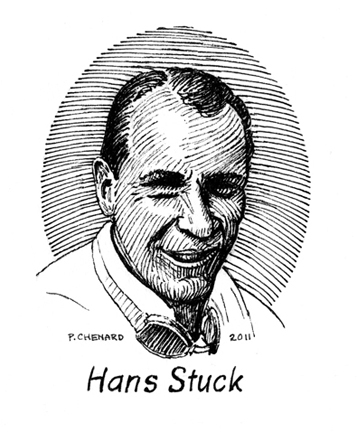
From race start, a battle developed between the leader, Auto Union driver Hans Stuck, and Mercedes driver Rudolf Caracciola. They pulled away from the rest of the pack, breaking lap record after lap record. 

Caracciola manage to get by Stuck at the Karussel curve and take the lead, but the strain was too much for the Mercedes W25’s engine, forcing him to retire.

Luigi Fagioi took up the chase in his teammate’s place, with Louis Chiron driving his Scuderia Ferrari Alfa Romeo P3 in a very distant third place, ahead of Nuvolari’s Maserati.

It was a resounding first win for Stuck and the Auto Union team, with an encouraging second place for Mercedes on the especially challenging track.

Wednesday, 9 February 2011

1934 Grand Prix de Monaco

As the first “Grande Épreuve” of the 1934 Grand Prix season, Monaco was, and has always been, a dramatic venue on the Mediterranean Sea.

It is one of few city courses in the world and considered the most prestigious of all the Grand Prix’s. The Monaco Grand Prix’s started in 1929 and it is still run today.


Guy Moll in an Alfa Romeo P3 rounding the Station Hairpin ahead of René Dreyfus in a Bugatti Type 59
Pen&ink, markers, and pencil on archival white stock 12”x 9” 
© Paul Chenard 2010

Original art & limited editions available.

For this April 2nd race, a few of the cars running needed modification to meet the new 750kg rules. Both the Mercedes-Benz and Auto Union teams decided they would not participate in any racing until the May 27th Avusrennen.

From the flag, the race lead changed hands quite often between the Bugatti T59 of René Dreyfus and the Scuderia Ferrari Alfa Romeo P3’s of Louis Chiron and “Guy” Moll.

Pen&ink © Paul Chenard 2010

Later in the race, while Chiron was in front, he had a slight off at the Station Hairpin, relinquishing his lead to Moll, who kept his position till race end.

It was a great start for this talented and popular 24-year-old Algerian rookie Scuderia Ferrari driver.

Wednesday, 14 July 2010

Philippe Étancelin – Private Racer

Philippe  “Phi-Phi” Étancelin was a French privateer racer who started racing in 1926, winning the Grand Prix de Reims. During his racing career, he drove Bugattis, Alfa Romeos, Maseratis, and Talbot-Lagos.

Born on December 28th, 1896 in Rouen (Normandy), he was a wool and down merchant through the Winter, and raced in the Summer. His wife Suzanne was his pit manager, giving him signals in French sign language.

In the illustration below, Étancelin is on his way to winning the French Grand Prix de Pau in 1930, driving his Bugatti Type 35C. He also won the race in 1936, driving his Maserati V8 R.I., one of only 4 produced!

Scratchboard 7”x 5” © Paul Chenard 2010

In 1934, he raced an Alfa Romeo with Luigi Chinetti in the 24 heures du Mans.

After he retired in 1953, the French government awarded him the Légion d'honneur for his contribution to the sport of automobile racing.

He passed away at the age of 85 years old in 1981. 

I want to personally thank André Étancelin for his help. Merci!

Friday, 5 June 2009

Mike Hawthorn 1929-1959

I now have my Mike Hawthorn sketch available as a limited edition of 50 Giclee prints.


Pen & ink with watercolour and Prismacolor pencils on white archival Strathmore stock
© Paul Chenard 2009

It is currently featured in the Automobilia section of Classic & Sports Car magazine. This has lead to the first order of the print from a gentleman in Boston; he ordered it for his very best friend's birthday in England, who is a Hawthorn fan.

Once I packaged it up for shipping, I decided to decorate the back of the packaging with an original marker rendering of Hawthorn racing a Ferrari in the 1958 Grand Prix de Monaco.


Markers on corrugated cardboard © Paul Chenard 2009

Birthdays should always have happy surprises!

Thursday, 27 November 2008

Formula 1 Prints - Driver/Constructor/Winner Series


1 Brabham BT19 1966
2 Eagle Weslake T1G 1967
3 McLaren M7A 1968

Pencil on paper © Paul Chenard 2007


The series highlights the 3 Formula 1 driver/constructors who won a race and gained championship points in the car they built.

Sir Jack Brabham won the World Driver's Championship for 1966, and Dan Gurney and Bruce McLaren both won a race in Spa in 1967, and 1968, respectively.

Sir Jack Brabham sent me a note when he saw the BT19 sketch:

Dear Paul,
Thank you for the very nice pencil sketch of the BT19.
Jack Brabham
Wow! I was thrilled to hear from Sir Jack directly.

Each illustration is available as a limited edition of 250 signed and numbered 17" x 14.5" premium archival Giclee prints for $125 CDN each plus shipping/handling.


Tuesday, 18 November 2008

Distinct Gift Idea – 1950’s Grand Prix Engines

Maserati 250F - Italy
© Paul Chenard 2008


Mercedes W196 - Germany
© Paul Chenard 2008

Talbot-Lago T26C - France
© Paul Chenard 2008

Vanwall 2.5L - England
© Paul Chenard 2008

Pencil and Prismacolor pencil on coloured paper 12"x9"

Grand Prix race cars of the 1950’s were interesting pieces of rolling engineering.

The French used the best bits of straightforward, tried and true racing technology for their racers, somewhat short of funding. The Germans developed highly engineered and tested machines; the British experimented with new technology and approaches, but were not always fully sorted. And the Italians pushed old technology to the full extent of its development, and always with flair.

National pride drove them all to push for the utmost in their machines, and they all carried their Nation’s colours into the melee; the Italian red, the British green, the French blue and the German silver.

Automobiliart.com offers a series of illustrations of 50’s Grand Prix Racing engines in International Racing Colours. There is the 1957 Maserati 250F in red, the 1956 Mercedes W196 in gray/silver, the 1950 Talbot-Lago T26C in blue and the 1957 Vanwall in green.


The series is available as limited edition premium archival Giclee prints, 14.5'x 11' (image size 12'x 9'), signed and numbered to a limit of 100 of each. The suggested retail price is $125 USD each plus shipping/handling, or all 4 for $445 USD plus shipping/handling.

Thursday, 21 August 2008

Fire and Ice: the 1933 Monaco Grand Prix


Pen & ink and Prismacolor pencils on archival white stock
© Paul Chenard 2008

The 1933 Monaco Grand Prix was fought with passion and coolness. The fiery Tazio Nuvolari squared off against the cool, reserved Achille Varzi in a race-long battle to win.

Nuvolari raced a Scuderia Ferrari team Alfa Romeo 8C Monza, swapping first place with Varzi's Bugatti Type 51 during 97 of the 100 laps of the race.

On the last lap, Nuvolari's over-heating racer finally broke down just ahead of the finish line and Varzi took the checkered flag. Nuvolari pushed his car across the line, but was disqualified because he was helped by a mechanic.

Sunday, 13 July 2008

Talbot-Lago T26C: La gloire de la France


All photos and illustration © Paul Chenard

One of my all-time favorite Grand Prix race cars has to be the Talbot-Lago T26C. It is such a beautiful piece of machinery, usually painted in it’s International Racing Colour French blue.

It was developed under the guidance of Anthony F. Lago, who had taken over the ailing SA Automobiles Talbot in 1935.

His company developed a straight-six competition 4.5 litre engine, mated to a Wilson pre-selector gearbox, and wrapped in a tradition yet gorgeous body.

Though not the most powerful racer on the grid, it was fuel-efficient, reliable and easy to pilot. These strengths became very apparent in races, and the T26C found some success in the hands of drivers like Louis Rosier, Louis Chiron, Philippe Étancelin, Guy Mairesse, Raymond Sommer and Pierre Levegh.

I was lucky enough to see, and sit in, the Talbot-Lago T26C of Aldo and Denis Bigioni at the Mosport Vintage Racing Festival in 2007.

It is a stunning example, this one sporting an egg-crate grill … perfect!


Prismacolor pencils and pencil on blue archival stock 12"x 9" © Paul Chenard 2008

Monday, 7 July 2008

Sir Stirling Moss O.B.E. - Monaco 1961


Pen & ink on film, each colour drawn separately then digitally lined up and coloured © Paul Chenard 2007

Sir Stirling Moss fought off the powerful shark-nose Ferrari 156's to win the 1961 Monaco Grand Prix in the Rob Walker Team's Lotus 18.

Wednesday, 16 April 2008

Tuesday, 25 March 2008

Paper Model: Maserati 250F

A few years ago, I designed a paper model of my all-time favorite Grand Prix car, a Maserati 250F. I did it completely from scratch,
drawing it a vector-based illustration program (Adobe Illustrator) so that I could resize it easily without compromising quality.
It takes about 3-4 hours to build it, but the results are
pretty satisfying.

Wednesday, 20 February 2008

Grand Prix Doodle


Ballpoint pen on paper © Paul Chenard 2007
Gordon MacLeod Collection

Doodle done during a board (bored?) meeting.

Monday, 18 February 2008

Driver/Constuctor/Winner Series


1 Brabham BT19 1966
2 Eagle Westlake T1G 1967
3 McLaren M7A 1968

The series highlights the 3 driver/constructors who won a race in the car they built. Pencil on paper © Paul Chenard 2007

Each illustration is available as a limited edition of 250 signed and numbered 17" x 14.5" premium archival Giclee prints.

Sir Jack Brabham sent me a note when he saw the BT19 sketch:

Dear Paul,
Thank you for the very nice pencil sketch of the BT19.
Jack Brabham
Wow! I was thrilled to hear from Sir Jack directly.