Showing posts with label Fagioli. Show all posts

Tuesday, 30 October 2012

Mercedes-Benz W25

Until 1934, three automotive companies dominated Grand Prix racing: Alfa Romeo, Bugatti, and Maserati. Each year, these companies produced racecars that were faster and more powerful than those of the previous year.

The Association Internationale des Automobile Clubs Reconnus (AIACR), the controlling body for motor sport in the 1930s, decided to change the requirements for the 1934, 1935, and 1936 Grand Prix seasons. The most important new requirement for the racers was that the maximum weight could not exceed 750 kg, excluding driver, fuel, oil, water, and tires.

The AIACR believed that Grand Prix cars were becoming too fast and reasoned that the change in weight parameters would limit the size of the engines used.

However, the AIACR had not at all taken into consideration the possibility of the manufacturers using new technology and lightweight metallurgy to create yet more powerful, efficient racers.

Mercedes-Benz saw an opportunity to move ahead, promoting their know-how and the sale of their products through Grand Prix racing.


Luigi Fagioli on his way to winning the 1935 Grand Prix de Monaco in the Mercedes-Benz W25.

I did this sketch while waiting for my Halifax flight at gate B05 at the Montréal airport on September 24th. The guy next to me practicing on his guitar; it was great to sketch to this guy's music.

Pen&ink, paint markers and markers on gray archival stock 12"x 9" © Paul Chenard 2012

Mercedes-Benz took a traditional approach with the front-engined rear-drive racer, but also took a serious look at using innovative aerodynamics and lightweight materials to give them an advantage. A steel-blocked 3.36-litre straight-8 supercharged engine powered the new Mercedes W25, and it was wrapped in a beautiful aerodynamic aluminum skin, with all-round independent suspension.

In that first year of the new formula, they won the Coppa Acerbo, the Italian Grand Prix and the Spanish Grand Prix. For 1935, they won 9 major races, giving driver Rudolf Caracciola the European Championship.

Wednesday, 6 April 2011

1934 German Grand Prix

After their humiliating defeat at the French Grand Prix by the Scuderia Ferrari team, the German teams were very determined to succeed on their home ground. With nearly 300,000 spectators, including officials of the Third Reich, there was considerable pressure to win.

1934 Grand Prix Season – German Grand Prix – Auto Union Type A
Limited edition of 50 – 14.5”x 11” (36.8 cm x 27.9 cm) – $150 USD plus S/H


The race took place on the long, grueling Nürburgring, called by many racers “the Green Hell.” With a length of over 28 kms (more than 17 miles) and having 187 turns through forests and changing elevations, it’s not difficult to see why.

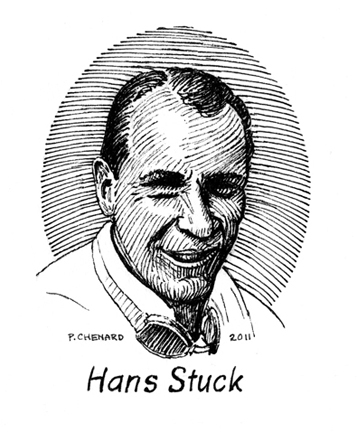
From race start, a battle developed between the leader, Auto Union driver Hans Stuck, and Mercedes driver Rudolf Caracciola. They pulled away from the rest of the pack, breaking lap record after lap record. 

Caracciola manage to get by Stuck at the Karussel curve and take the lead, but the strain was too much for the Mercedes W25’s engine, forcing him to retire.

Luigi Fagioi took up the chase in his teammate’s place, with Louis Chiron driving his Scuderia Ferrari Alfa Romeo P3 in a very distant third place, ahead of Nuvolari’s Maserati.

It was a resounding first win for Stuck and the Auto Union team, with an encouraging second place for Mercedes on the especially challenging track.

Wednesday, 17 November 2010

1934 Eifelrennen Formule Libre

At the Nurburgring track, bad weather delayed this important race by a few hours.

Mercedes-Benz was making its first official entry into the Grand Prix season at this event after extensive testing and adjustment of the new W25.

Team manager Alfred Neubauer was feeling the pressure to succeed in their homeland. Their star driver had not yet fully recovered enough from his 1933 Monaco crash to participate so Mercedes brought in a new driver
Manfred Georg Rudolf von Brauchitsch, along with Luigi Fagioli to drive their new racer.

Pen&ink, markers, and pencil on archival white stock 12”x 9” 
© Paul Chenard 2010
Original art & limited editions available.
Auto Union had Hans Stuck, Hermann zu Leiningen and August "Bubi" Momberger to drive their Type A.

Scuderia Ferrari had Louis Chiron and Mario Tadini driving the Alfa Romeo P3. Bugatti had no entries in the race, and nor did Maserati.

Three classes of cars were racing together, flagged off one class after another, a total of forty-four cars in all.

Italian Fagioli took an early lead until he was ordered by team manager Neubauer to let his German teammate
von Brauchitsch by. Later in the pits for fueling, Fagioli argued furiously with Neubauer over this. He started off again, but with only one lap remaining in the race, he pulled over and abandoned his race car in protest.


With two Auto Unions out of the race, Stuck had taken the sole remaining Type A to a sizeable lead over von Brauchitsch. Some believed he would go non-stop and win the race. He finally did have to come in for fuel and tires, and the Mercedes driver took the lead, which he would keep to the checkered flag.

The win was a stunning debut for both the Mercedes-Benz team and their new driver.

Wednesday, 20 October 2010

1934 Italian Grand Prix

The Italian Grand Prix was held on September 9th at the Autodromo Di Monza. In the previous year’s Grand Prix, serious accidents had taken the lives of Giuseppe Campari and two other drivers. To lessen the speeds, it was decided that the track should be shortened from 10kms to 4.3kms, with many chicanes added in. With 500kms to cover for the Grand Prix, this made for a longer, more grueling race.

Mercedes had their W25, Bugatti their Type 59, Scuderia Ferrari the Alfa P3, while Maserati introduced the new model 6C-34, to be driven by Tazio Nuvolari. The balance of their team would drive the 8CMs.

Pen&ink, markers, and pencil on archival white stock 12”x 9” © Paul Chenard 2010
Original art & limited editions available.

At the start, Hans Stuck took an early lead for Auto Union but was soon overtaken by Mercedes driver Rudolf Caracciola. His teammate Manfred Georg Rudolf von Brauchitsch was not competing, having been injured in a crash at the previous Swiss Grand Prix. Battling amongst the leaders were Luigi Fagioli (Mercedes), Archille Varzi (Alfa Romeo), Nuvolari (Maserati) and Count Carlo Felice Trossi (Alfa Romeo).

Unfortunately for Nuvolari, the Maserati mechanics forgot to top-up his car's brake fluid after weigh-in, so he slowly lost his brakes during the long race.

The 4.75 hour race, with it’s 1600 total corners, took a toll on the drivers and the cars. Fagioli, whose car broke down, later replaced Caracciola, who had to be lifted out of his car. Stuck had to be replaced by zu Leiningen, and Trossi by Comotti.

Varzi dropped out with mechanical woes, so the race finished with Caracciola/Figioli in first place, Stuck/zu Leiningen in second, with Trossi/Comotti in third. After 4th place Chiron (Alfa Romeo), Nuvolari finished a respectable 5th place, using his gears to brake for the last half of the race.